Technical Basics, Safety & Care
Power Bank Ports Explained: Choosing USB-C and Built-In Cables
17th Sep•9 min read
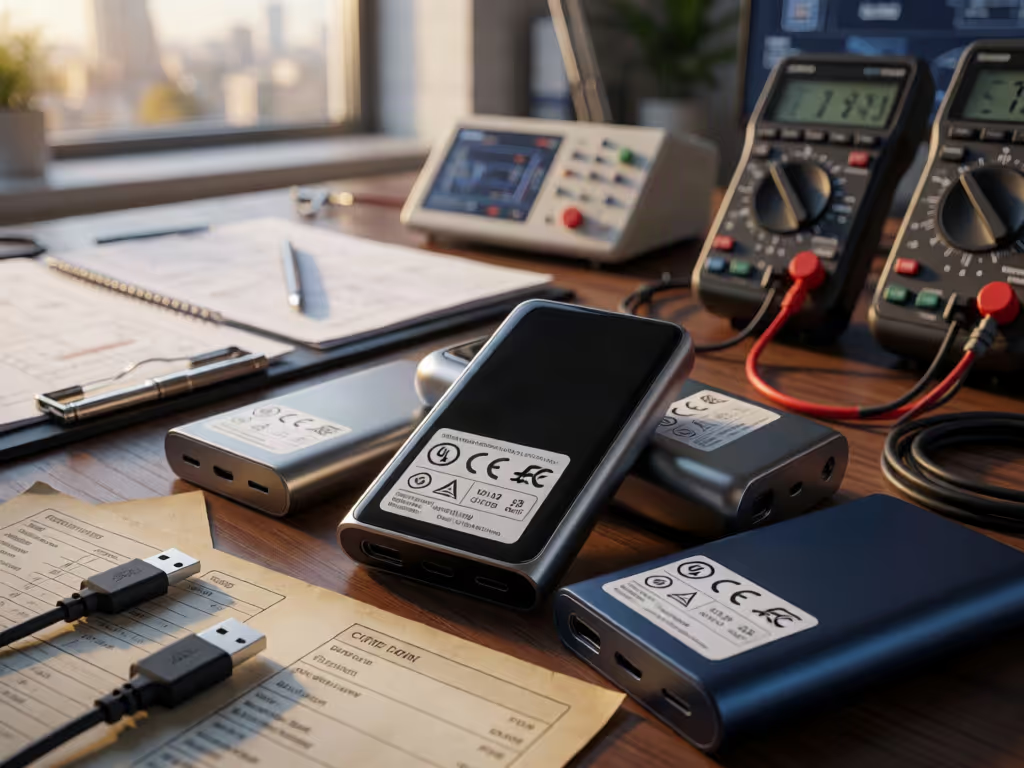
Read a power bank label by matching each claim to its actual scope, then verify the exact model before relying on it.
Important: A logo or generic statement does not, on the available evidence, verify a specific power bank’s compliance. The evidence also does not support a universal visual-authentication checklist for these marks.
Power bank certification explained starts with a useful reset: power bank compliance labels are not one all-purpose safety score. A mark or standards reference can relate to battery safety, transport classification, radio-frequency emissions, EU legal documentation, or hazardous-substance restrictions. Reading each label for its actual job helps you avoid both false reassurance and unnecessary anxiety.
A power bank is an easily carried external power source, and IATA says power banks are generally made up of multiple cells. One line on its case cannot describe every part of the product. The practical goal is to identify the label, match it to the question you are asking, and request documentation that names the exact model when that decision matters.
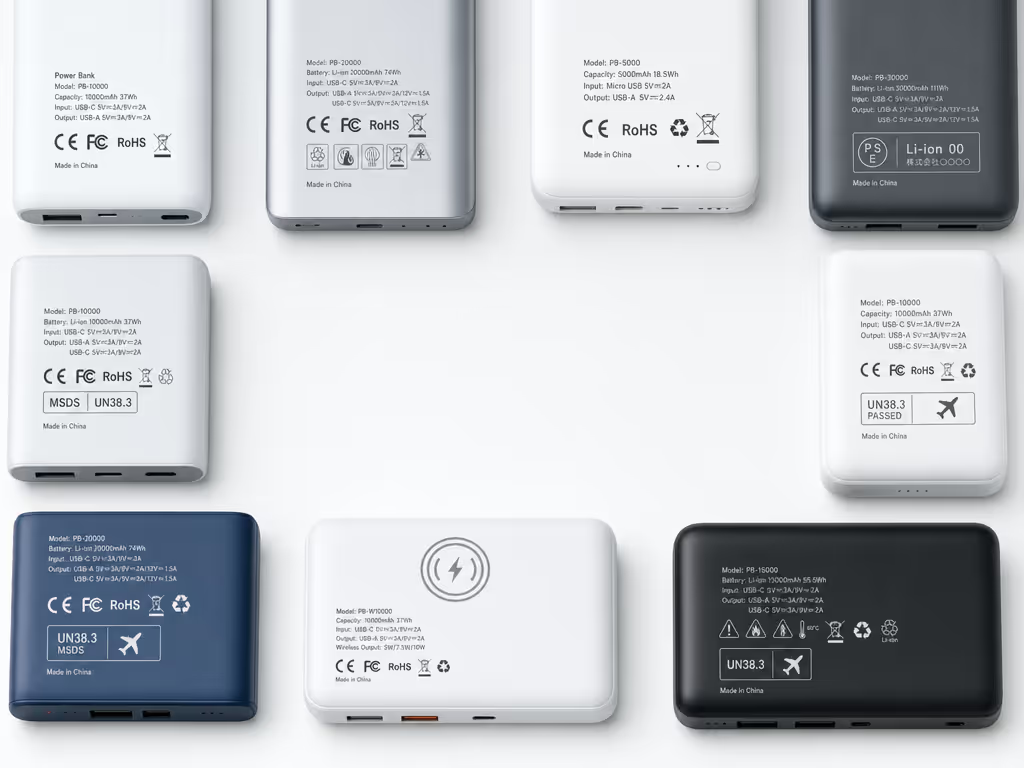
Compliance labels provide context; they do not serve as a single all-purpose safety score.
The meaning of UN 38.3 is commonly misunderstood. Subsection 38.3 of the UN Manual of Tests and Criteria addresses procedures for the classification of lithium-metal and lithium-ion cells and batteries. In practical terms, it belongs to the transport world: the movement of lithium batteries through shipping and travel channels.
It does not mean that a power bank has passed every kind of consumer-product safety assessment. IATA's 2026 operator guidance makes that distinction explicitly: UN 38.3 conformance is relevant when transporting or travelling with batteries, but it is not a consumer-product safety standard.
Think of the scope this way:
UN 38.3 reference
 ↓
Lithium-battery transport/classification context
 ↓
Useful for shipping and travel documentation questions
 ≠
A complete verdict on consumer-product safety
That distinction matters when you are comparing products for daily use. A seller's UN 38.3 statement may be relevant, but it does not answer whether the finished power bank's protective functions, enclosure resilience, and thermal safety were assessed under a consumer-product standard.
A UL 2056 power bank claim points to UL 2056, which UL Solutions identifies as the Standard for Power Banks. According to UL Solutions, its testing framework covers several risks that matter to someone carrying a battery in a bag every day:
That is a much closer fit for the question, "Has the finished power bank been evaluated for key consumer-use hazards?" UL Solutions says certification to UL 2056 can help demonstrate consumer-safety testing and regulatory compliance. A logo by itself, however, does not establish the status of the particular unit in your hand.
The actionable step is narrower and stronger: ask for material that identifies the precise model (not merely a generic statement such as "UL compliant"). Product names, model or type identifiers, and the organization responsible for the claim are more useful than a detached badge in a marketplace image.
No. The IEC 62133 battery standard, specifically IEC 62133-2:2017, specifies requirements and tests for the safe operation of portable sealed secondary lithium cells and batteries containing non-acid electrolyte.
The scopes overlap in the broad area of battery safety, but they are not interchangeable labels. IEC 62133-2 speaks to portable sealed lithium cells and batteries; UL 2056 is identified by UL Solutions as a standard for power banks. A real power bank combines battery cells with a finished consumer product, so keep the claim tied to the standard named.
IEC 62133-2
 → portable sealed lithium cells and batteries

UL 2056
 → power banks as finished products

UN 38.3
 → lithium-battery transport/classification context
This is why a single "certified" word is not enough for a careful buyer. Ask: Certified or assessed to which standard, for what scope, and for which exact model?
The shorthand CE FCC RoHS labeling often gets treated as a three-checkmark scorecard. It is more accurate to separate the terms.
For applicable EU requirements, the EU declaration of conformity is a mandatory legal document signed by the manufacturer or authorised representative. A manufacturer placing a finished product on the EU market under its own name or brand is responsible for the declaration for the entire finished product, even if individual components are already CE marked.
For a buyer, the useful evidence is an EU declaration of conformity that identifies the product by serial number, model, or type. The declaration also includes the responsible manufacturer or representative, applicable legislation, the standards or other means used to show compliance, and a signature and date. The most recent declaration must be retained for 10 years after the product is placed on the EU market and made available to market-surveillance authorities on request.
A CE mark therefore should prompt a documentation question: Can the seller or manufacturer provide a declaration that matches this exact power-bank model? It is not enough to assume that a visual mark alone proves the product listing, factory, or batch you are considering.
FCC equipment authorization concerns RF devices in electronic and electrical products capable of emitting radio-frequency energy. The appropriate authorization procedure can vary by device type and electrical functions. A product can contain multiple devices, and more than one procedure may apply.
So do not use "FCC" as a blanket battery-safety label. It answers an RF-regulatory question for products and functions within the relevant FCC scope, not whether the battery pack has transport classification or whether its cell protections were evaluated under UL 2056.
EU RoHS restricts hazardous substances in electrical and electronic equipment to protect environmental and public health. The European Commission currently lists ten restricted substances, while also noting that exemptions and amendments exist.
RoHS is valuable environmental-compliance information. It is not proof of lithium-battery transport conformance, power-bank drop resistance, or charging performance.
Use this four-question scan before you buy or travel.
What does this reference actually cover? Transport classification, consumer-product safety, RF authorization, EU conformity documentation, and substance restrictions are different categories.
Does the claim identify the exact model? A model or type identifier is especially important for EU conformity documentation. Generic claims are weak decision material when you need to rely on the product.
Who is responsible for the claim? Look for a manufacturer or authorised representative rather than treating a marketplace bullet point as the whole record.
Does the label answer my real concern? A UN 38.3 reference helps with transport context. It does not establish every consumer-safety attribute. RoHS addresses restricted substances, not runtime or thermal output behavior.
For a separate discussion of power-bank ports and cables, see our guide.
Do not decide from mAh alone. A capacity stated only in mAh cannot be directly evaluated against a watt-hour limit without voltage information. Look for the bank's Wh rating on the unit or its exact-model documentation, then check your airline's current policy before travel.
IATA's March 2026 operator guidance says personal-use power banks must be in carry-on baggage. For a broader look at power banks and airline compliance, check the current travel-specific guidance before packing. It also describes a no-more-than-two-per-person provision and says a 100-160 Wh power bank requires operator approval. But that guidance is time-sensitive, adoption can depend on the state, and the document itself describes changes that are not permanent. The guidance also says power banks must not be recharged aboard an aircraft and should not be used to recharge a portable electronic device while on board.
The reliable travel path is:
Find Wh on the specific bank
 → check the operating airline's current policy
 → keep the bank in carry-on baggage
 → follow crew instructions on board
A generic standard name or logo is not, on the available evidence, sufficient to verify a specific power bank's compliance. The available evidence also does not establish a universal visual-authentication method for UL, CE, FCC, RoHS, UN 38.3, or IEC 62133 claims.
The available evidence does not establish whether packaging language shows that the tested configuration, factory, or production batch matches the item being sold.
Treat labels as the start of verification, not the endpoint. Favor exact-model documentation, a clearly identified responsible manufacturer, and a claim whose scope matches the risk you are trying to manage.
The smartest purchase decision separates two layers:
That framework is less exciting than chasing a logo, but it is far more dependable. For your next comparison, pull the exact model identifier first and map each compliance claim to its real scope. Predictable decisions begin before you buy.