Shopping & Deals Guides
Power Bank With Percentage Display: Buyer’s Runtime Guide
25th Sep•12 min read
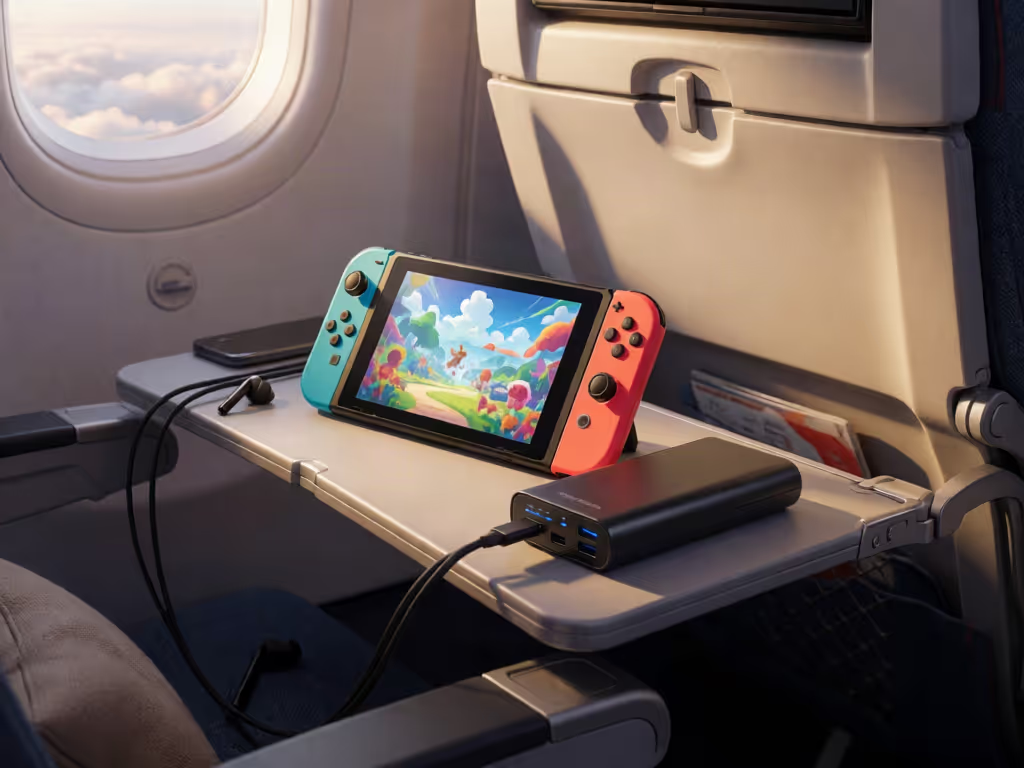
The UGREEN Nexode 25,000mAh 145W is the strongest supported choice here for carrying a Switch alongside larger USB-C devices.
Finding the best power bank for Nintendo Switch is less about chasing the largest number on a listing and more about avoiding the frustrating outcome where a bank connects but your game session still drains the battery. For anyone shopping for a power bank for handheld gaming console use, one carefully qualified pick stands out: the UGREEN Nexode 25,000mAh 145W. It is a high-output, three-port bank listed as Switch-compatible, but its ability to add charge during active Switch gameplay has not been independently verified.
That distinction matters. "Compatible" can mean the console accepts power; it does not, by itself, prove the bank will maintain battery percentage in your particular game, with your particular cable. The cable is a component, not an accessory.
Choose the UGREEN Nexode 25,000mAh 145W if you want a substantial bank that can serve a Switch and larger USB-C devices from one pack, and you accept that the Switch claim comes from the retailer listing rather than a play-while-charging test.
Do not choose it solely because you expect a proven number of extra Switch hours. No measured Switch runtime, delivered watt-hours, or active-game charging test is available. That means a precise session-extension promise would be marketing, not a useful answer.
Its strongest documented case is broader than Nintendo: this is a 25,000mAh, high-output bank with a retailer-listed 145W total maximum output and one USB-C port listed up to 140W. An independent review also describes it as a three-port, large-device-oriented bank with a 140W USB-C input/output port.
The practical win is not "145W for a Switch." It is buying one bank whose ports and cable setup leave room for your handheld and the rest of your USB-C kit.
The UGREEN Nexode 25,000mAh 145W is a portable power bank with three outputs: two USB-C ports and one USB-A port. The retailer lists 25,000mAh capacity, 145W maximum total output, and up to 140W from USB-C1. An independent review similarly reports a configuration of one dual input/output USB-C port, one dedicated USB-C output, and one USB-A output.
The retailer includes Nintendo Switch among its compatible devices. It also lists Steam Deck compatibility, making the bank relevant if your travel bag covers both a Switch and a Steam Deck power bank role. Treat both as stated compatibility claims, not as independently measured charging-rate results.
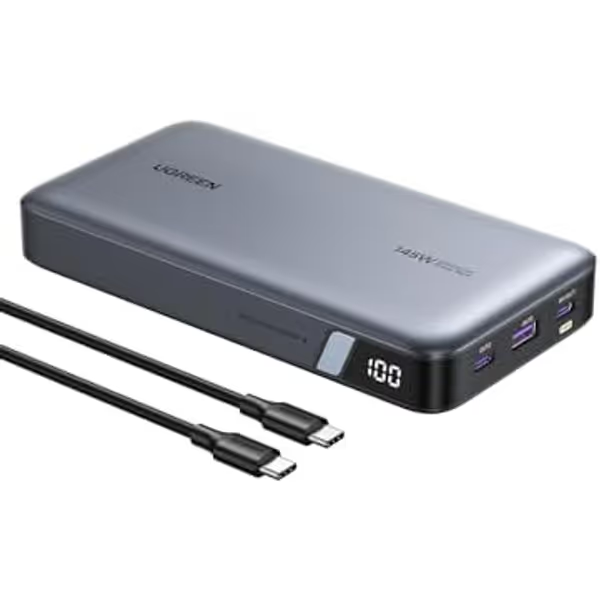
The 140W single-port figure tells us the high-output USB-C port has far more headroom than a handheld-only accessory bank. The 145W figure is the listed total maximum, so do not read the product page as a guarantee that every connected device receives its preferred maximum at the same time. The available information does not detail how power is shared between ports under a Switch plus phone plus laptop load.
Likewise, 25,000mAh is a retailer-listed capacity figure, not a measured promise of how many hours a game will run; our guide to power bank mAh ratings explains why labeled and usable capacity differ. The available evidence includes no published delivered-energy test for this bank or Switch session test. Avoid converting the mAh label into a confidently stated number of recharges or gaming hours.
That may sound cautious, but it is the useful kind of caution. If you need an all-day handheld plan, test your own console, game, brightness, wireless use, and cable at home before depending on it for a flight or train day.
The retailer says the UGREEN bank is compatible with Nintendo Switch. That supports a reasonable starting point: it is intended to work with the console.
However, there is no independent evidence that verifies any of the questions that decide whether a Nintendo Switch portable charger feels successful in real use:
So the honest answer is: it is listed as compatible, but play-while-charging performance is unverified.
For handheld use, keep the setup uncomplicated:
UGREEN high-output USB-C port
 ↓
USB-C-to-USB-C cable rated for the bank's intended performance
 ↓
Nintendo Switch USB-C port
The retailer advises using the included 5A USB-C-to-USB-C cable or another certified 5A cable for full performance and device compatibility. That is the cable guidance tied specifically to this product. Pair the cable right: start with that included cable rather than an unidentified spare from the bottom of a bag.
Do not assume a cable is interchangeable simply because both ends fit. I have seen a supposedly fast bank look like a slow charger until the cable was swapped; the bank was not the bottleneck. For this UGREEN, the manufacturer's own guidance points you toward its included 5A cable or a certified equivalent.
Because the key gaming scenario is not independently tested, validate it yourself while you can return or exchange gear if it fails your needs:
This does not turn one home test into a universal benchmark. It does give you the answer that matters: whether your console-and-cable path behaves predictably.
For a Switch alone, it is not clear how much of that 145W total is useful to the console. But high output can still be useful at the pack level when one bank is expected to cover more than gaming.
The UGREEN's documented advantage is flexibility:
This makes it a plausible "one larger bank" option for a player carrying a handheld, phone, and small accessories. What remains unknown is the exact shared-port allocation and whether simultaneous use affects Switch charging behavior. If your mission is strictly one Switch and nothing else, this is not necessarily the best-value or lightest choice; the available evidence does not compare it with smaller banks.
A ROG Ally power bank buyer should apply the same discipline, and our gaming power bank guide explains why sustained wattage and thermal management matter during extended play. Look for device-specific, active-play testing and published port-sharing behavior rather than assuming a high total-wattage number proves a result. This does not establish ROG Ally compatibility for the UGREEN model.
An independent reviewer reports a weight of 1 lb. 1.8 oz. That is meaningful gear weight, particularly if you normally pack light. In exchange, you get a bank positioned for larger electronics rather than a pocket-sized emergency top-up.
The same review observed a full recharge time of 6 hours 39 minutes using the reviewer's usual wall charger and USB-C cable test setup. By contrast, the retailer claims approximately two hours when the bank is charged with a 65W PD charger, which is not included. The retailer also says a 20W adapter can take up to six hours.
These are not directly comparable results because the independent test does not specify the wall charger's output. The planning takeaway is straightforward:
Wall charger + USB-C cable → power bank input → stored energy → handheld
Your refill window depends on the charger and cable at the left side of that diagram. If rapid turnaround matters, do not budget around the retailer's approximately two-hour figure unless you are also bringing a 65W PD charger and a suitable cable.
The independent review also reports pass-through charging, meaning devices can be plugged into the bank while the bank is connected to an outlet. That can make a hotel-room setup tidier, but it is not a substitute for testing your own Switch, cable, and wall charger combination before relying on it.
For U.S. passenger flights, the FAA says power banks must go in carry-on baggage, not checked baggage; see this airline compliance guide for broader travel-planning considerations. Spare lithium-ion batteries up to 100Wh are allowed; 101-160Wh require airline approval, with limits; anything above 160Wh is prohibited.
The important gap: the watt-hour rating for this UGREEN product is not confirmed. Do not infer airline eligibility from its 25,000mAh label alone, even though the retailer calls it airline-friendly. Check the watt-hour marking on the physical unit and verify your airline's current policy before travel; airlines and international rules may be stricter.
It is more accurate to call it a high-output USB-C gaming console charger option than to call it the fastest. The UGREEN is listed at 145W maximum total output and 140W from one USB-C port, and the independent review reports the same 140W capability for the dual input/output USB-C port.
But no like-for-like power-bank comparison, Switch charging test, or device-specific rate test supports calling it the fastest. High bank output and fast charging at the console are related but not identical; this PD-versus-QC charging comparison explains how protocol compatibility affects real-world charging.
The UGREEN Nexode 25,000mAh 145W is a sensible pick for the traveler or creator who wants one substantial bank for a Switch plus larger USB-C gear. Its strongest supported features are its 25,000mAh retailer-listed capacity, 145W total maximum output, 140W USB-C port, three-port layout, and high-input recharge claim when paired with a 65W PD charger. The independent review adds useful real-world context: the bank is about 1 lb. 1.8 oz., supports pass-through charging and low-current mode, and took 6 hours 39 minutes to refill in that reviewer's unspecified charging setup.
For Switch-only buyers, keep the decision narrower: it is retailer-listed as Switch-compatible, but it has not been independently verified as a bank that will maintain or increase charge during gameplay. Bring the included 5A USB-C cable, test the exact setup before departure, and keep the handheld connection direct.
Further exploration starts with your own compatibility matrix: console → cable → chosen bank port → game-load test. Once that chain works at home, your travel setup becomes far more predictable than any vague "fast charge" badge can make it.