Child Safe Portable Power Banks: A Parent’s Compliance Guide
By Hana El-Sayed • 2nd Sep
Quick answer
A power bank should not be labeled child-safe solely because of its mAh, Wh, protective case, or marketplace listing. Parents should verify a specific UL 2056 testing or certification claim, then enforce supervised charging and damage checks.
- Short answer: Choose documentation and condition over appearance: use compatible charging equipment, charge on a hard surface while attended, and stop using any bank that becomes unusually hot, swollen, damaged, leaking, or unusually smelly.
- Key distinction: As of September 2026, the FAA’s usual 100 Wh limit is an air-travel carriage rule, not a child-safety threshold. Under that U.S. FAA passenger-aircraft guidance, power banks must be carried in carry-on baggage, with terminals protected from short circuits.
- Important caveat: Airlines may impose stricter or changing requirements, including quantity limits and onboard-use restrictions.
Portable power banks can keep a child's phone, school tablet, or accessibility device available when it matters. But a power bank should not be labeled child-safe solely because of its capacity or a marketplace listing. It is a unit selected with traceable safety evidence, compatible charging equipment, and household rules that prevent heat, damage, and unsupervised charging.
For parents, the useful question is not "What is the safest-looking bank?" It is: "Can I verify the safety features, set clear handling limits, and pack it according to applicable travel rules?"
Safety documentation and household rules are features, not afterthoughts.
What makes a power bank appropriate for a child to use?
There is no evidence-based mAh or Wh threshold that makes a power bank inherently safe for children. A smaller capacity, a protective-looking shell, or a marketplace description alone is not sufficient evidence of safety.
Instead, evaluate the system: the bank, its charging equipment, its condition, and the adult-controlled routine around it. A practical acceptance screen is below.
Parent acceptance criteria before purchase or handoff
- For air travel, determine the bank's Wh rating. As of September 2026, FAA guidance generally limits personal rechargeable lithium-ion batteries to 100 Wh per battery, although airlines may apply stricter rules.
- Look for a demonstrable UL 2056 testing or certification claim. UL 2056 is the Standard for Power Banks. Its scope includes overcharge and over-discharge protection, short-circuit and overload testing, drop and impact resistance, and thermal safety. A claim should be specific enough for you to identify the standard being cited, not merely a vague "multi-protection" statement.
- Use appropriate charging equipment. Family guidance recommends using the supplied charger and cable, or a compatible set from the same manufacturer. Avoid unknown, bargain charging accessories whose power regulation is uncertain.
- Inspect before every trip or school week. Do not issue a bank that is damaged, swollen, leaking, or unusually smelly.
- Make the rules part of the gear. The child should know where charging may occur, when to ask an adult for help, and what to do if the bank becomes unusually hot.
A protection circuit is valuable, but it is not permission to ignore damage or heat; review this power bank safety usage guide for broader handling and storage practices. Thermal runaway can follow factors including damage, overheating, water exposure, overcharging, improper packing, or a manufacturing defect.
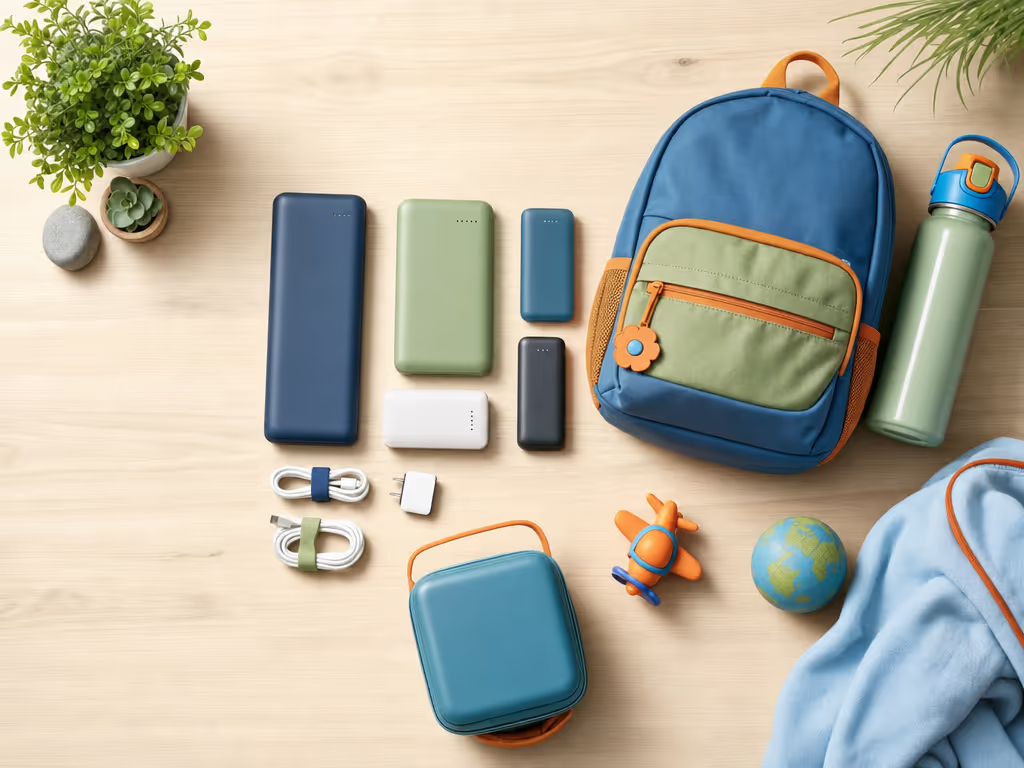
How should charging work for school?
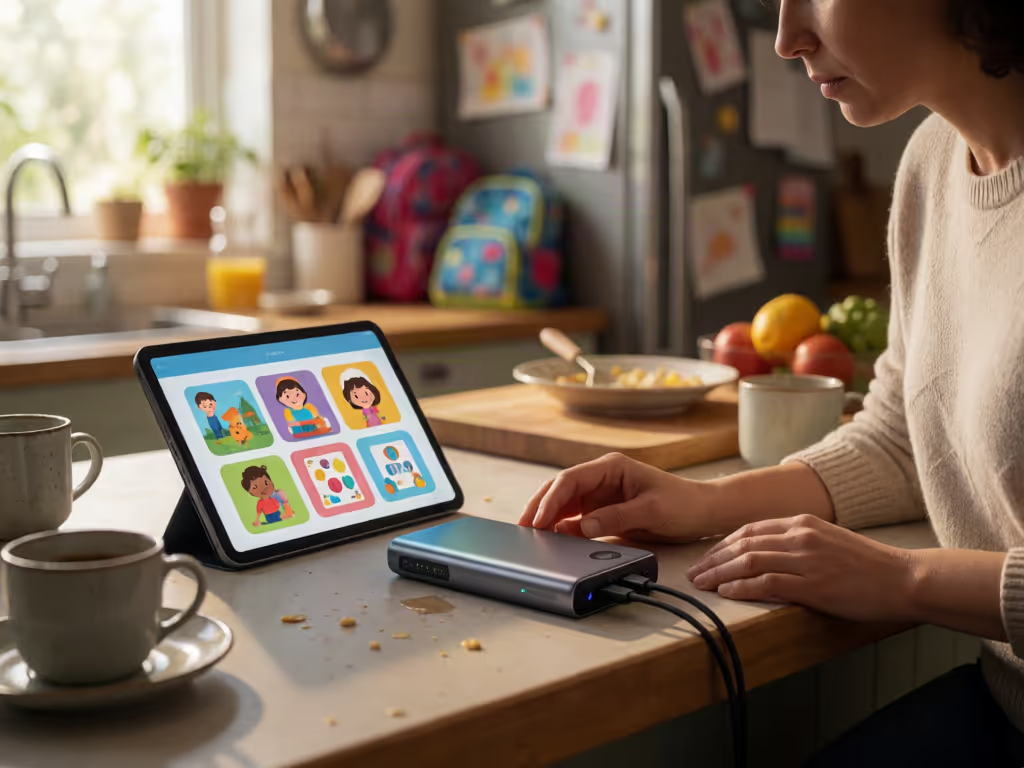
For school charging, use a clear routine. Charging should happen on a hard, flat surface away from easily ignited materials while attended—not buried among books, clothing, or loose supplies.
The simple home-and-school protocol
- Charge on a hard, flat surface away from easily ignited materials. Beds, blankets, pillows, and couch cushions can trap heat.
- Do not charge unattended, particularly overnight. Build charging into an evening routine when an adult is nearby.
- Unplug immediately if the bank becomes unusually hot. Let the adult decide the next step; the child should not troubleshoot it by reconnecting the cable.
- Keep damaged batteries out of children's hands. Stop using a swollen, leaking, damaged, or unusually smelling unit. Contact the manufacturer or local waste-disposal service for direction.
- Avoid cold-weather charging below 0°C (32°F) unless the specific product instructions say otherwise. General technical guidance warns against charging consumer lithium-ion batteries below that temperature; the manual for the particular bank remains the controlling operating guidance.
This approach supports sensible power bank safety for kids without treating a case or sticker as sufficient safety evidence. For habits that also help preserve the bank's performance over time, see this guide to power bank maintenance. It keeps expectations simple and visible.
A quick risk matrix for family tech safety
| Situation | What raises risk | Parent mitigation | Acceptance criterion |
|---|---|---|---|
| Overnight recharge | No one notices abnormal heat | Charge while an adult is awake and nearby | Bank is unplugged after the supervised session |
| Charging on soft furnishings | Heat can be trapped | Use a hard, flat, clear surface | No bedding, cushions, or blankets under or around it |
| U.S. air travel as of September 2026 | Unintended terminal contact | Protect the terminals from short circuits | No visible damage; terminals cannot contact metal objects |
| Hot, swollen, leaking, or odd-smelling unit | Possible battery failure | Stop use; keep children from touching it | Manufacturer or local disposal guidance is obtained |
| Below-freezing charging | General lithium-ion cold-charge concern | Wait for an appropriate temperature and follow the manual | No charging below 0°C/32°F absent product-specific instructions |
Does UL 2056 mean a power bank is child-safe?
No standard converts a portable battery into a toy. The guidance reviewed here does not set an age threshold or supervision standard for independent child use. UL 2056 is, however, a meaningful evidence point when you are screening products.
According to UL Solutions' description of the standard, UL 2056 addresses the failure modes parents care about most: overcharge and over-discharge protection, short circuits, overload, impact, and thermal safety. UL Solutions states that certification can help demonstrate consumer-safety and regulatory-compliance testing.
The word demonstrable matters. Do not equate an unverified retail claim, a rubberized exterior, or a seller's "drop-resistant" language with testing to UL 2056. If you cannot establish what standard is claimed for the exact unit, treat that as a documentation gap, not as proof of danger, but as a reason not to make a confident safety claim.
This is the compliance-forward way to evaluate a child safe power bank: for travel, determine its Wh rating; for safety screening, identify the claimed safety standard, retain the instructions, and enforce the charging routine.
What should parents do about recalls or a damaged bank?
Treat a recall notice as a specific identification task. For example, the December 5, 2025 CPSC recall of certain INIU BI-B41 power banks applied only to units with affected serial-number prefixes; it was not a conclusion about every INIU product or every 10,000mAh bank. The stated hazard for the affected units was overheating and ignition, with fire and burn risk.
If your unit appears in a recall notice, stop using it immediately and follow the recall process to verify the serial number and obtain the offered remedy. Keep records where you can find them quickly.
For a bank that is swollen, damaged, leaking, or unusually smelly - even without a recall - stop use and keep it away from children. Do not place lithium-ion batteries in household trash or curbside recycling; follow these compliant power bank disposal steps. Use a designated battery-recycling location, or follow recall instructions where applicable.
Can a child take a power bank on a flight?
As of September 2026, FAA passenger guidance treats power banks containing lithium-ion batteries as spare batteries for U.S. air travel. They must be in carry-on baggage only. Under that guidance as of September 2026, if a carry-on bag is gate-checked or checked planeside, remove the power bank and keep it with the passenger in the cabin.
As of September 2026, the FAA's general size limit for most personal rechargeable lithium-ion batteries is 100 Wh per battery; consult this airline compliance guide for power banks for broader travel-planning details. That is an aviation carriage threshold (not a child-safety rating). As of that date, the FAA also describes a possible airline-approved exception for up to two spare batteries exceeding 100 Wh and not exceeding 160 Wh; families should not assume that exception applies to every airline or itinerary.
Flight-ready packing checklist
- Confirm the bank's Wh rating before leaving home.
- Pack the bank in carry-on baggage, not checked baggage.
- Protect terminals from short circuit so they cannot contact metal objects. FAA examples include a protective pouch, sleeve, battery case, taped terminals, or retail packaging.
- Under FAA guidance current as of September 2026, if the bag is gate-checked, remove the bank first.
- Check the operating carrier's current policy before every trip, including quantity limits and any limits on in-flight use or charging.
IATA's 2026 operator guidance calls for carry-on carriage, individual short-circuit protection, no more than two power banks per person, and no onboard recharging of the bank or use of it to recharge another portable electronic device. Its implementation depends on state adoption and airline rules, and the document itself is temporary through December 31, 2026. That is why the carrier's current instructions are the final travel acceptance criterion.
FAQ: Which portable power bank is the safest?
The evidence does not support naming one safest model. Choose by verification rather than appearance: a specific and demonstrable UL 2056 testing or certification claim, intact condition, appropriate charger and cable, and a supervised hard-surface charging routine.
FAQ: What power banks are allowed by TSA?
This guide addresses FAA and airline carriage guidance, not a separate TSA screening ruling. Under FAA guidance current as of September 2026, power banks containing lithium-ion batteries belong in carry-on baggage only, and most personal rechargeable lithium-ion batteries are generally limited to 100 Wh each. Airlines may be stricter, so check the operating carrier before departure.
FAQ: What is the best power bank for school?
There is no supported basis to name a best school model. For school use, use appropriate charging equipment, recharge only on a hard, flat surface while attended, and stop using any unit that is damaged, swollen, leaking, unusually smelly, or unusually hot.
Further exploration: make compliance visible
Create a one-page family tech safety card and keep it where devices charge: hard surface, adult nearby, stop for unusual heat, no use if damaged, no trash disposal, follow airline carry-on rules for flights. For flights, compare each bank's Wh rating with the operating carrier's policy and keep the manufacturer's documentation location in your travel checklist. Keep the checklist with your travel documents.
That modest audit reduces uncertainty for parents, gives children simple boundaries, and makes the next school day or airport checkpoint far more predictable.
Related Articles
Shopping & Deals Guides
Best Power Banks for Content Creators in 2026: Camera, Laptop & Phone Picks
6th May•12 min read
Shopping & Deals Guides
Power Bank Trade-In Value: Stop Losing Money on Battery Health
18th Jan•8 min read