
Best Power Banks for Content Creators in 2026: Camera, Laptop & Phone Picks
By Anika Bose • 6th May
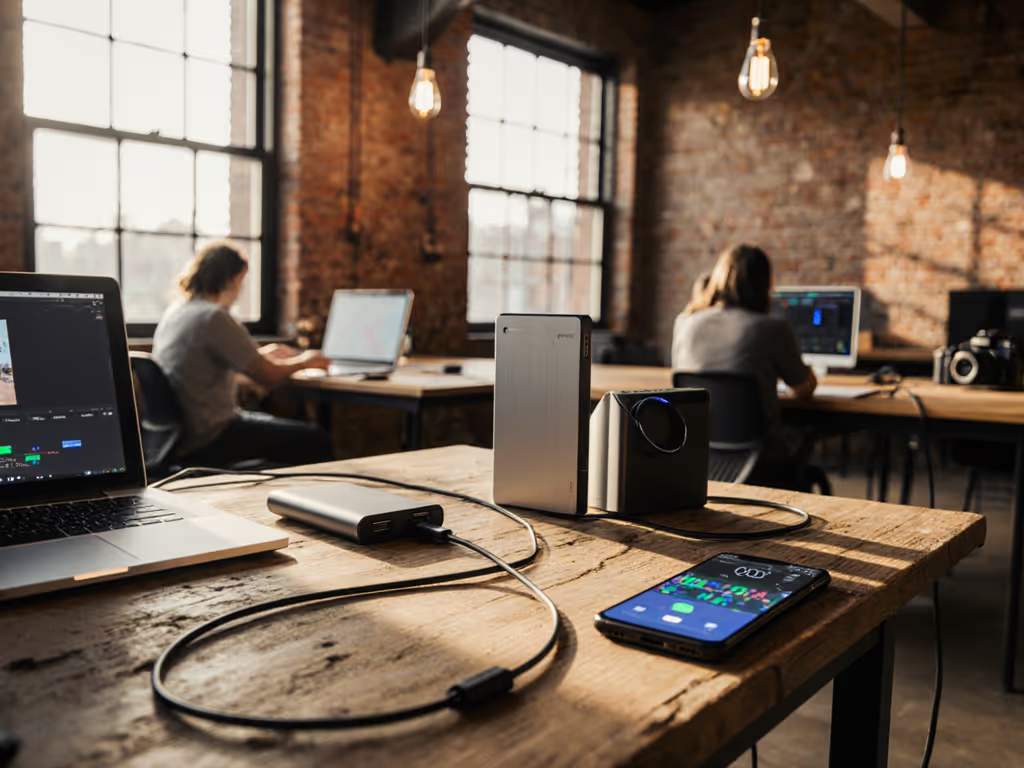
Finding the best power bank for content creators is not about buying the largest number printed next to "mAh." A creator needs the right USB-C contract for the laptop, predictable power sharing when the phone joins the load, and enough energy to finish the shoot. Labeled capacity is not the same thing as delivered USB-output energy, so this is a protocol-first shortlist, not a fantasy runtime chart.
“PD-capable” on a label is not the same thing as a documented result with a particular laptop. Show me the PD trace, not just the printed specs. To understand how PD and QC protocols actually negotiate power, read our PD vs QC power bank guide.
The available evidence supports three clearly identified products: UGREEN's 200 W Nexode, Anker's 140 W 737 PowerCore 24K, and INIU's lighter 100 W Cougar P63. The available material is primarily manufacturer specification material, with one UGREEN reviewer observation. Trace or it didn't happen.
The short answer: choose by load topology, not capacity hype
Provisional winners by documented specification
- Best documented high-output workstation bank: UGREEN Nexode 25000mAh 200W. It has the highest documented shared-output ceiling: 200 W total, with USB-C1 rated at 140 W and USB-C2 at 100 W. UGREEN also publishes PPS support. This is the strongest paper-spec option for a creator whose laptop and second USB-C load must run together, but its output allocation needs independent capture before treating it as a field guarantee.
- Best 140 W-class single-laptop option: Anker 737 Power Bank (PowerCore 24K, A1289). Its 140 W total output and 140 W USB-C1 input are explicitly documented. Anker also states the exact condition for reaching 140 W: a PD 3.1-capable cable and a device that accepts PD 3.1 input.
- Best compact documented 100 W option: INIU Cougar P63 / P63-E1. At 392.3 g, it is materially lighter than the UGREEN and Anker units documented here, while USB-C1 is rated at 100 W. Its published multi-port information conflicts internally, however, so treat it as a one-main-device bank until its shared-load behavior is logged.
For the Anker 737 specifically, its 140 W peak requires the PD 3.1-capable cable and PD 3.1-capable receiving device that Anker specifies. Its documentation also says the 140 W total is divided between two active USB-C devices according to their input needs.
Figure 1: published specification matrix, not a delivered-energy test
Test conditions: None. Values below are manufacturer-published specifications except the single UGREEN reviewer observation noted in the table. This is a specification-led comparison, not a runtime chart.
| Model | Labeled capacity / energy | Ports | Highest stated single-port output | Stated shared output | Input | Weight | What the evidence actually supports |
|---|---|---|---|---|---|---|---|
| UGREEN Nexode 25000mAh 200W, SKU 35525 | 25,000 mAh / 90 Wh | 2 × USB-C, 1 × USB-A | USB-C1: 140 W | 200 W total | 65 W | 592 g EU page; 609 g US page | Highest verified published shared-output ceiling |
| Anker 737 Power Bank (PowerCore 24K), A1289 | 24,000 mAh | 2 × USB-C, 1 × USB-A | 140 W total via USB-C | 140 W divided across two USB-C devices | 140 W via USB-C1 | 630 g | Clear 140 W PD 3.1 condition; do not assume 140 W per USB-C port |
| INIU Cougar P63, P63-E1 | 25,000 mAh | 2 × USB-C, 1 × USB-A | USB-C1: 100 W | Published figures conflict; 65 W + 15 W chart for three ports | 65 W | 392.3 g | Compact 100 W option; multi-port result needs verification |
The UGREEN's regional pages disagree on physical dimensions and weight, so neither figure should be presented as universal. The published EU weight is 592 g and the US weight is 609 g. That is not a rounding issue a technical comparison should hide.
UGREEN Nexode 25000mAh 200W: best on documented multi-device headroom
The UGREEN Nexode Power Bank 25000mAh 200W with Smart Digital Display is the best documented option here for creators who genuinely have two large USB-C loads. Its official specifications list a 90 Wh labeled battery, 200 W maximum total output, 140 W maximum on USB-C1, 100 W on USB-C2, and 22.5 W on USB-A. UGREEN's EU page says it can provide dual 100 W output to two laptops simultaneously; that remains a manufacturer claim, not an independently measured cross-load result.
For a power bank for filming and vlogging, that output topology is more meaningful than a vague "laptop compatible" badge. A laptop, a phone, a USB-C light, and an accessory battery create a shared-load problem. The UGREEN is the only bank in this group with a published 200 W total ceiling and separately stated 140 W / 100 W USB-C ceilings.
Its published USB-C protocol list is unusually broad: PD 3.0, PD 2.0, PPS, QC4+, QC3.0, QC2.0, AFC, Apple 5 V/2.4 A, and BC1.2. PPS support is a listed protocol, but the collected evidence does not establish a particular phone's charging rate or mode. Device-side requirements and cable capability were not documented in the research set.
One independent reviewer reported up to 90 W while charging a MacBook Pro using a 100 W cable. That is useful as a single observation, not a universal result, and it is well below the bank's 140 W USB-C1 ceiling. The missing evidence is exactly what matters in an edit suite or on location: the PD log, source capabilities, the sink's request, and a sustained power trace under a second live load.
Who it suits: creators operating a high-draw laptop plus a second USB-C device, where the published 200 W shared ceiling is the deciding requirement.
What to verify before purchase: your regional physical specification, your laptop's accepted USB-C input profile, and whether the retailer's unit matches SKU 35525. If you need 100 W plus 100 W in a real shoot, demand a test that records voltage, current, temperature, and contract changes over time, not a two-device marketing photo.
Anker 737 PowerCore 24K: the clearest 140 W contract requirement
The Anker 737 Power Bank (PowerCore 24K), model A1289, has a 24,000 mAh labeled capacity, two USB-C ports, one USB-A port, and a documented 140 W maximum total output. It measures 155.7 × 54.6 × 49.5 mm and weighs 630 g. The USB-A port is rated at up to 18 W.
Its advantage is not low mass; it is documentation clarity around the peak-rate condition. Anker says 140 W requires both a PD 3.1-capable cable and a device supporting PD 3.1 input. That means a creator cannot unlock the claimed peak merely by plugging in a USB-C cable that happens to fit. The link must support the required power path, and the laptop must request it.
The multi-port caveat is equally explicit: when both USB-C ports are active, the 140 W total is divided according to the connected devices' input needs. This is the right way to read a shared-output specification. It is not two simultaneous 140 W USB-C outputs.
Anker also publishes 140 W maximum input through USB-C1. That is potentially useful for a short hotel or studio recharge window, but the dossier contains no timed 0-100% recharge test. Do not turn the input ceiling into a promised recharge duration.
Who it suits: a creator with one PD 3.1-capable high-demand laptop who values a clearly stated 140 W prerequisite and accepts a 630 g pack.
INIU Cougar P63: the lightweight 100 W pick (with a multi-port warning)
The INIU Cougar P63 100W High Capacity Laptop Power Bank, model P63-E1, is the portability play. INIU lists a 25,000 mAh capacity, 110 × 70 × 36 mm dimensions, and a 392.3 g weight. That is 199.7 g lighter than the UGREEN's EU-listed 592 g weight and 237.7 g lighter than the Anker's 630 g weight.
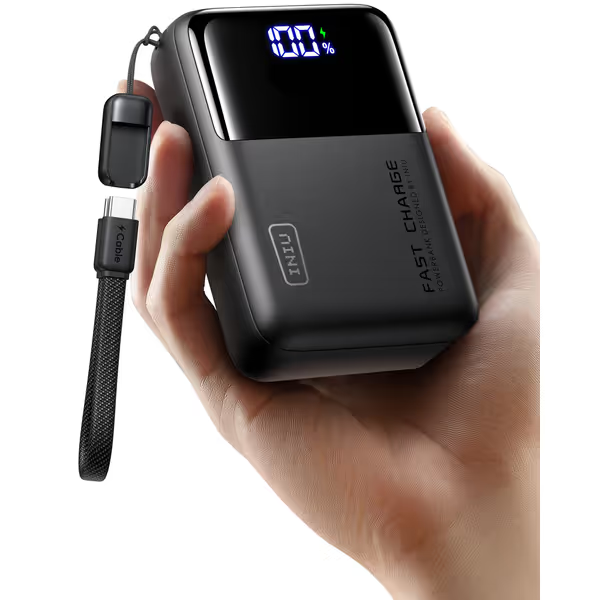
INIU 100W 25000mAh Power Bank
Airline-safe 100W power bank for laptops, phones, and gaming devices.
$59.99
Output Power100W
Output Power100W
Pros
Simultaneously fast-charges multiple high-power devices.
Compact, airline-approved 25000mAh for travel.
Ensures full-speed gaming for handheld consoles.
Cons
Detachable cable means losing it is possible.
The port arrangement is two USB-C ports and one USB-A port. Published individual ceilings are 100 W on USB-C1, 45 W on USB-C2, and 18 W on USB-A. INIU includes a detachable 100 W USB-C GoCord cable and lists PPS, PD 3.0, PD 2.0, QC, AFC, and FCP support. The manufacturer also lists several DJI models (including Mini 2 SE, Mini 4 Pro, Mavic 3 Pro, Air 3S, and Air 3) as compatible devices. That is a manufacturer compatibility list, not a measured charging-rate result for a drone, camera, or battery system.
There is an important documentation fault line. INIU's power-distribution chart publishes 65 W + 45 W for the two USB-C outputs, and 65 W + 15 W for all three outputs. Elsewhere, the technical specifications say 80 W maximum for all three ports, while a comparison chart says 163 W total output maximum. Those cannot all describe the same simultaneous-load condition.
For that reason, I would use the 65 W + 15 W chart as the cautious planning number for a laptop-plus-accessory setup and would not select this model for a mission that demands a verified three-device high-power load. The 100 W USB-C1 single-port rating remains the meaningful documented case.
Who it suits: the creator who wants the lightest of these documented options for one main USB-C laptop or other primary device, with secondary charging treated conservatively.
What to verify before purchase: do not rely on the page's 163 W comparison-chart figure for concurrent use. Ask for an instrumented load test showing each port's voltage and current, plus whether connecting USB-A causes the USB-C contract to renegotiate.
Camera, laptop, and phone: the buying method that avoids mid-shoot surprises
A power bank for camera laptop and phone use should be selected from the load backward.
1. Start with simultaneous watts, not the number of ports
Write down the actual devices you expect to power at once. Then identify the critical load, the device that cannot be allowed to drop to a lower-power profile. For many creators, that is the laptop. The output ceiling must cover the combined documented load allocation, not just the largest printed port number.
- A single high-demand laptop favors the Anker's documented 140 W path or the INIU's 100 W USB-C1 path, depending on the device requirement.
- Two substantial USB-C loads favor the UGREEN on published specifications, because it alone documents a 200 W total ceiling and 140 W / 100 W USB-C port ceilings.
- A laptop plus low-demand accessories may fit the INIU's cautious 65 W + 15 W published three-port allocation, but its conflicting data means it is not the no-surprises multi-device choice.
2. Treat the cable as part of the power bank
The Anker's own documentation makes this unavoidable: its 140 W result requires PD 3.1 support on the cable and receiving device. Do not assume a physically identical cable carries an identical capability. If your workflow needs Anker's specified 140 W path, use a cable and receiving device that meet Anker's PD 3.1 requirement.
3. Separate labeled capacity from delivered energy
UGREEN labels its pack at 90 Wh. The others are listed in mAh in the available primary evidence. This article uses those labeled capacity figures and does not convert them into phone charges, camera-battery charges, or laptop runtime.
So this article will not convert labeled mAh into phone charges, camera-battery charges, or laptop runtime. For fundamentals on rated mAh versus real USB-output energy, see Power Bank mAh explained. Those outcomes depend on the conversion path and load behavior.
4. Do not outsource travel compliance to product copy
At the time the UGREEN regional pages were collected, UGREEN described this 90 Wh pack as airline-approved and suitable for planes. That is manufacturer marketing, not carrier-specific travel advice. For airline limits, country rules, and packing tips, consult our power banks for travel compliance guide. Check the current rules for your specific carrier and route, and use the energy label on the physical unit as your starting document.
What the documented specifications cover
The best portable charger for creators should have evidence beyond a specification table. This review relies on product specifications and one limited independent UGREEN observation. The documented record covers:
- Published capacities, port configurations, output ratings, input ratings, dimensions, and weights for the UGREEN, Anker, and INIU models.
- Anker's stated PD 3.1 cable-and-device requirement for its 140 W peak rate and its two-USB-C power-sharing statement.
- UGREEN's published protocols and its manufacturer claim of dual 100 W laptop output.
- INIU's published port ratings, cable inclusion, supported protocols, DJI compatibility list, and internally conflicting multi-port figures.
- One reviewer-reported UGREEN MacBook Pro result of up to 90 W with a 100 W cable.
These are not nitpicks. They are the difference between a bank that looks capable in a listing and one that keeps an editing laptop alive while a phone and accessory begin charging. Until those logs and delivered-energy curves exist, no one should promise your exact runtime or fast-charge mode.
Final verdict
For creators who need the strongest documented shared-power specification, choose the UGREEN Nexode 25000mAh 200W, with the explicit caveat that its real multi-device behavior still needs a captured test. For a single PD 3.1-capable laptop that can use a 140 W path, the Anker 737 PowerCore 24K A1289 has the clearest published requirement: compatible PD 3.1 device and cable. For minimum carry mass with a documented 100 W primary USB-C output, the INIU Cougar P63/P63-E1 is the sensible compact option, but its contradictory multi-port figures rule it out for a critical high-power three-device setup.
This is a specification-led shortlist rather than a completed lab comparison.
Buy for the power contract you can prove, not the capacity you hope will translate into runtime. Trace or it didn't happen. If you're broadcasting or recording on the go, our best power banks for streamers and podcasters distills picks for IRL and studio workflows.
Related Articles
Shopping & Deals Guides
Power Bank Trade-In Value: Stop Losing Money on Battery Health
18th Jan•8 min read
Shopping & Deals Guides
Portable Power Banks for E-Scooters: Verified Urban Commuter Solutions
13th Jan•8 min read
Shopping & Deals Guides
Therapeutic Power Banks: Precise Charging for Recovery Devices
2nd Jan•7 min read