Technical Basics, Safety & Care
Real-World Power Bank Capacity: mAh to Device Charges
10th May•9 min read
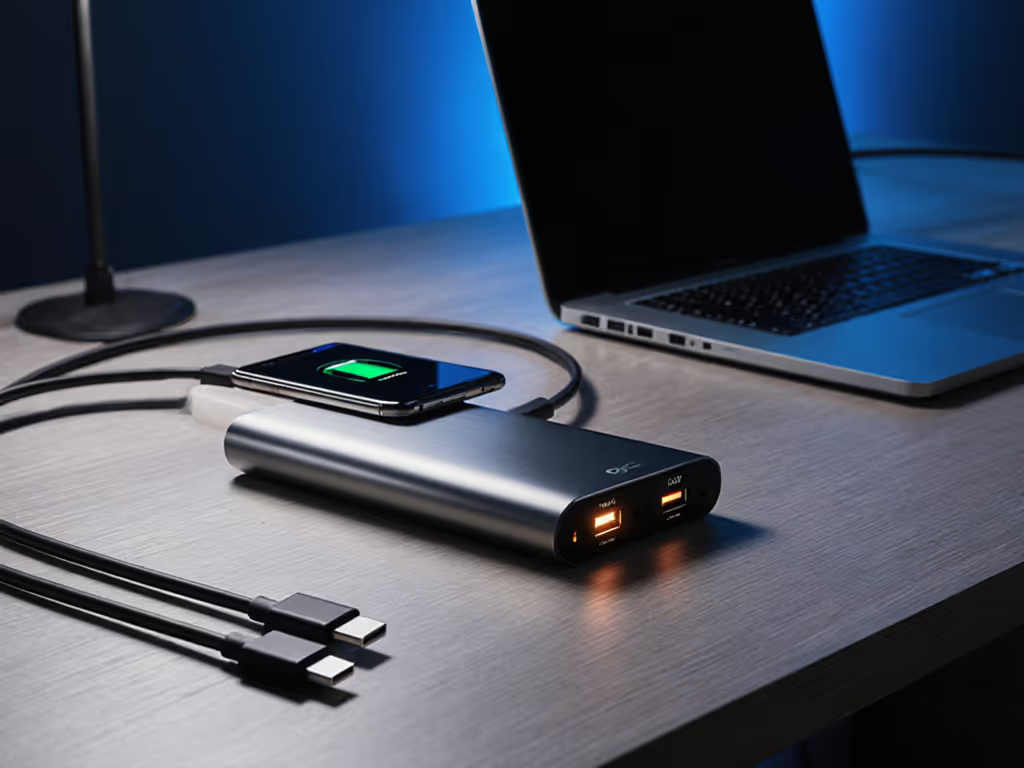
Selecting a power bank with fast charging capability requires understanding input wattage optimization as critically as output specifications. Many travelers and professionals assume high-output wattage alone guarantees rapid device charging, yet overlook how slowly their bank recharges itself, a critical flaw when layover windows or field work demand immediate readiness. An Anker fast charging power bank exemplifies strategic input/output balance, but even premium models fail without protocol-aware pairing. This FAQ deep dive dissects the normative references cited in IEC 62133-2 and UN38.3 to transform technical specs into actionable fast recharge techniques for mission-critical scenarios.
Labels prevent losses
Self-recharge duration depends on three interdependent factors, each governed by safety standards referenced in UN38.3 Section 38.3.4.3:
Input Protocol Compatibility: A 65W USB-C PD power bank won't accept 65W input unless your charger negotiates precisely matching voltage/current profiles (e.g., 20V/3.25A). Mismatched PD 3.0/PPS triggers fallback to 18W (9V/2A), extending recharge time by 200-300%. Normative references in IEC 62684:2018 mandate this voltage negotiation sequence.
Cable Limitations: E-marked cables rated for 100W+ (5A) are essential for >60W input. A standard 3A cable throttles 100W input to 60W, creating a bottleneck. Verified by USB-IF compliance tests, thin-gauge cables also cause 15-20% power loss through resistive heating.
Protection IC Throttling: Banks like the Anker Prime Power Bank deploy dual-input architectures to enable 140W+ input, but thermal sensors must reduce input current when cell temperature exceeds 45°C (per UN38.3 Test 4). This safety feature, often mistaken for malfunction, prioritizes cell integrity over speed.

Avoid inflated "0-100% in X hours" claims by auditing these four elements from a technical compliance perspective:
Labeling Language Precision: Check for explicit watt-hour (Wh) and input wattage (W) markings. "20,000mAh" alone violates IATA Packing Instruction 967; compliant units display "74Wh" (critical for airline readiness). Missing Wh labeling triggers confiscations (I've seen perfectly functional banks seized because labels skipped this mandatory field). If you're unsure how mAh translates into Wh for airline checks, see our mAh-to-Wh capacity guide.
UN38.3 Test Summary: Reputable brands include test certificates validating thermal stability during high-wattage input. Section 38.3.4.5.3 requires banks to withstand 1.2x max input current for 1 hour without thermal runaway.
Input Protocol Disclosure: Look for "PD 3.0 Input: 100W Max". Vague terms like "supports fast charging" indicate incomplete engineering. PD 3.1 EPR (28-48V) input enables 140W+ but requires explicit labeling per IEC 62368-1.
Thermal Derating Curves: Manufacturers testing to UL 2056 publish temperature/wattage graphs. A bank accepting 100W input at 25°C may throttle to 60W at 35°C. Absent public data, assume 20-30% throttling in warm environments.
Field testing reveals three evidence-based failure modes invisible in spec sheets:
Power Sharing Errors: When charging multiple devices while recharging, input power diverts to outputs. A 60W-input bank charging a 30W laptop may draw only 30W from its charger, doubling self-recharge time. Clear acceptance criteria per IEEE 1725:2017 require 1.5x input wattage versus max simultaneous output. For simultaneous charge-and-recharge scenarios, our pass-through charging guide explains certified requirements and limitations.
Voltage Sag from Low-Quality Adapters: PD chargers with poor voltage regulation (±5% tolerance) fail negotiation. A 20V charger dipping to 19V during load won't sustain 100W input (100W = 20V × 5A). This explains why "100W chargers" often deliver only 65W in practice.
Battery State Impact: Lithium polymer cells accept max input only at 20-80% state-of-charge (SoC). Below 20% SoC, protection ICs limit input to 50% rated wattage per UN38.3 safety protocols. Above 80%, taper charging reduces input current by 40-60% to prevent lithium plating.
Here, input wattage optimization directly intersects with transportation safety. IATA requires clear labeling of watt-hours (Wh) and verification of UN38.3 compliance documentation. Crucially:
Airlines measure capacity in Wh, not mAh. For policy details and packing tips, read our airline compliance guide. A 20,000mAh bank at 3.7V = 74Wh (20,000 × 3.7 ÷ 1,000), staying under the 100Wh carry-on limit.
Banks exceeding 100Wh (e.g., 27,000mAh+) require airline approval and explicit UN38.3 certification. Without this paperwork, even 99Wh units risk confiscation for ambiguous labeling.
This is where Labels prevent losses. During a 2023 Frankfurt checkpoint audit, I witnessed a traveler lose a 26,850mAh bank because its label read "100Wh" (incorrectly calculated) instead of the actual 99.3Wh. The airline's handheld meter detected the discrepancy. Proper labeling would have permitted carriage, proof that normative references aren't bureaucratic hurdles but tangible trip-savers.
Follow this evidence-based protocol matching framework:
| Device Input Requirement | Minimum Charger Spec | Critical Cable Spec | Risk Mitigation |
|---|---|---|---|
| 30-65W PD Input | 65W PD 3.0 (20V/3.25A) | 5A E-marked USB-C (20V/5A) | Confirm 97% voltage stability under load via POWER-Z tester |
| 100W PD Input | 100W PD 3.0 (20V/5A) | 5A E-marked USB-C (20V/5A) | Avoid shared sockets, as a dedicated circuit prevents voltage sag |
| 140W+ PD 3.1 EPR Input | 140W+ PD 3.1 EPR (28V/5A) | 5A EPR-certified cable | Operate below 30°C ambient; monitor cell temp via thermal camera |

Note: Qualcomm QC5/VOOC input requires proprietary chargers. Universal PD input remains the safest choice for cross-device readiness. If you routinely target 100W+ input/output, compare models in our sustained 100W power bank tests to avoid thermal throttling and voltage sag.
True power bank input efficiency emerges from aligning three pillars: protocol-perfect charger pairing, thermally aware usage, and regulatory-compliant documentation. Input wattage isn't just a speed metric, it is a safety parameter tested under UN38.3's rigorous frameworks. When your work trip hinges on a 45-minute layover recharge, conservative engineering with complete labeling becomes your most valuable feature.
For further exploration, consult the IEC 62684:2020 amendment covering USB-PD 3.1 EPR input requirements or the IATA Lithium Battery Guidance Document (Edition 2025). These sources provide the precise labeling language and voltage negotiation tables essential for evidence-based procurement. Remember: comprehensive documentation isn't paperwork, it is the feature that keeps your power bank in your carry-on, not in security's bin.
Labels prevent losses.