
Real-World Power Bank Capacity: mAh to Device Charges
By Anika Bose • 10th May
The Gap Between Spec and Reality
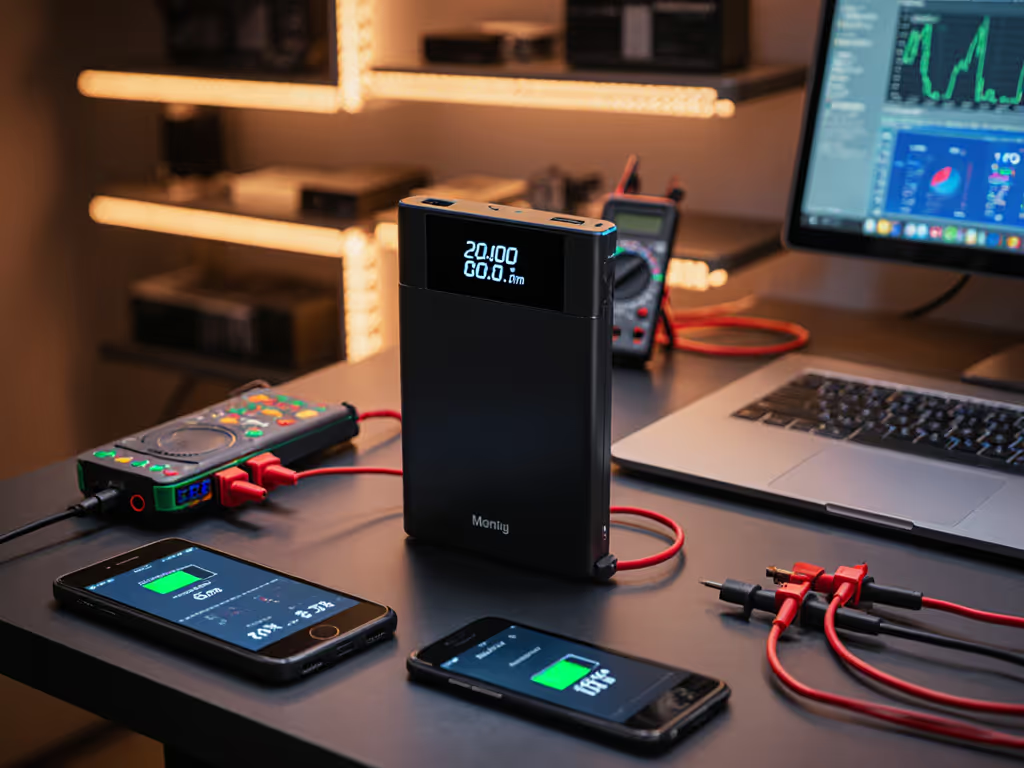
The printed mAh and Wh ratings on power banks are almost never what hits your device. A 10,000 mAh bank advertises 10,000 milliampere-hours, but if you actually charge a phone, you'll land somewhere between 6,000 and 7,500 mAh - a 20-40% shortfall that frustrates creators, remote workers, and travelers. That gap isn't fraud; it's physics, protocol overhead, and conversion losses baked into every connection. But knowing where it comes from and how to calculate real-world delivered capacity is the difference between predictable reliability and a dead device mid-task.
This guide decodes the mAh to device charges calculator pathway: spec sheets, efficiency formulas, voltage conversion, protocol negotiation, and the measurement discipline that separates marketing claims from traced, logged reality. If the data doesn't prove the claim, the claim doesn't count.
FAQ: Real-World Power Bank Capacity
Why Does My Power Bank Deliver So Much Less Than Its mAh Rating?
The mAh rating on the label reflects the battery cell's nominal voltage and capacity, typically 3.7 V or 3.8 V. Your bank's USB output, however, is 5 V. The voltage step-up happens inside the power management IC (PMIC), and the process is lossy: internal resistance, inductor heating, diode drops, and thermal throttling all consume energy.
Additionally, the bank must account for:
- Quiescent current (the IC idling 30-50 mA just to stay powered)
- Connection negotiation overhead (USB Power Delivery handshaking, typically 1-2% of total energy)
- Cable and connector resistance (especially with unrated or low-AWG cables)
- BMS calibration drift (batteries naturally degrade; a 2-year-old bank's real capacity may be 85-95% of its rated value)
A typical efficiency chain: Cell capacity (Wh) -> PMIC conversion (loss 10-15%) -> Connection overhead (loss 1-2%) -> Delivered Wh = real-world usable energy.
A 10,000 mAh bank at 3.7 V nominal stores approximately 37 Wh. After a realistic 85% end-to-end efficiency, the user receives ~31.5 Wh at 5 V, translating to roughly 6,300 mAh at 5 V - a 37% loss from the printed spec.
How Do I Calculate Real Capacity Using the Efficiency Formula?
Two formulas dominate power bank efficiency calculations:
Formula A (mAh-based):
Real Capacity (mAh @ 5 V) = Printed mAh × (Cell Voltage / Output Voltage) × Efficiency
Example: A 10,000 mAh bank with 3.7 V cells and 85% efficiency:
10,000 × (3.7 / 5) × 0.85 = 6,290 mAh @ 5 V
Formula B (Wh-based, more reliable):
Real Capacity (mAh @ 5 V) = Printed Wh × Efficiency / (5 V × 0.001)
Example: A 37 Wh bank with 85% efficiency:
37 × 0.85 / (5 × 0.001) = 6,290 mAh @ 5 V
Why Formula B is more authoritative: Wh (watt-hours) is an absolute energy quantity, independent of voltage. A bank claiming 50 Wh stores exactly 50 watt-hours, regardless of internal cell topology. Manufacturers sometimes understate Wh or omit it entirely (a red flag for opacity).
Plug in realistic figures:
- Printed capacity: 5,000-50,000 mAh or equivalent Wh
- Cell voltage: 3.7 V (older single-cell banks) or 3.8 V (modern multi-cell packs)
- Output voltage: 5.0 V (standard USB-A) or higher via USB-PD negotiation
- Efficiency: 82-90% for reputable banks; below 82% suggests poor PMIC design or aged cells
How Does USB Power Delivery Affect Delivered Capacity?
This is where protocol-level visibility becomes critical. When a bank and device connect via USB-C, they exchange Power Delivery contract messages (USB PD spec r3.0 and r3.1 EPR). The negotiation determines voltage, current, and power profile:
- 5 V / 2 A = 10 W (USB default)
- 9 V / 2 A = 18 W (Qualcomm QC)
- 15 V / 2 A = 30 W (USB PD 2.0)
- 20 V / 5 A = 100 W (USB PD 3.0)
- 28 V / 5 A = 140 W (USB PD 3.1 EPR, high-power laptops)
At higher voltages, efficiency can improve because lower current means reduced I^2R losses in the cable. For a clear breakdown of PD vs Quick Charge compatibility, see our side-by-side fast charging guide. However, if the bank's PMIC cannot negotiate the contract the device requests, or if device firmware has a race condition, the negotiation may fail silently or bounce between profiles.
I once worked with a client whose laptop kept rebooting whenever a 'PD-capable' bank was attached. I clipped a PD sniffer inline and watched the contract bounce from 20 V to 5 V and back; firmware bug confirmed. The bank was standards-compliant; the laptop's BMS had a flaw. Without the trace, the bank would have been wrongly blamed. Trace or it didn't happen. Verify protocol logs before trusting fast-charge claims.
How Many Device Charges Can I Realistically Expect From One Bank Cycle?
Divide real-world delivered Wh by your device's battery Wh, then apply a device charging cycle calculation adjustment for transfer inefficiency:
Full Cycle Count = (Bank Delivered Wh × 0.95) / Device Battery Wh
Example:
- Bank: 50 Wh nominal, 85% efficiency → 42.5 Wh delivered
- Apply 5% cable/connector loss: 42.5 × 0.95 = 40.38 Wh
- Phone: 15 Wh battery
- Result: 40.38 / 15 = 2.69 full charges (realistic expectation)
For multi-device scenarios, math gets murkier: If you routinely charge three or more devices, our multi-device power bank comparison tests real-world distribution efficiency and priority algorithms.
- Two ports active simultaneously often trigger current splitting and thermal throttling, reducing total throughput by 10-20%.
- Low-current devices (earbuds, smartwatches) may trigger the bank's auto-shutoff, wasting 5-10% of remaining charge.
Practical reference table (single-device, 85% efficiency, 22 °C ambient): For deeper data on how heat and cold shift real capacity, see our temperature performance analysis.
| Bank (Wh) | 10 Wh Device | 15 Wh Device | 20 Wh Device |
|---|---|---|---|
| 25 Wh | 2.1 | 1.4 | 1.1 |
| 50 Wh | 4.3 | 2.9 | 2.1 |
| 100 Wh | 8.5 | 5.7 | 4.3 |
Why Do Efficiency Numbers Vary So Much Between Banks?
PMIC quality: A cheap switching regulator runs 78-82% efficient. A high-grade IC with better magnetics and lower quiescent draw hits 88-92%.
Cell quality: Aged or mismatched cells degrade faster, reducing usable capacity per charge cycle.
Thermal management: Banks with passive cooling throttle hard under sustained 2+ A load, dropping efficiency 5-10%. Models with active temperature sensing maintain flatter curves.
Cable and connector fit: Loose connectors add 0.2-0.5 Ω of parasitic resistance. A 24 AWG cable at 2 A can lose 0.5 V across 1.5 m, slashing delivered power by 5-10%. This is voltage conversion losses explained in real hardware.
What's the Difference Between Spec, Tested, and Delivered Capacity?
Three layers exist:
- Spec (Printed, often inflated): The mAh or Wh label; often rounded up or measured under ideal, non-thermal conditions.
- Tested Capacity (Measured in lab, constant conditions): Discharged at fixed current (1 A or 2 A) from 100% to 0%, accounting for standard losses. Many review channels use this, and it's repeatable but not realistic.
- Delivered Capacity (Real-world, variable load): What the end user receives after USB negotiation, cable drop, device BMS losses, and thermal throttling under typical usage (charging a phone at 1-3 A, then a laptop at 5-10 A, all in a 20-30 °C environment).
Delivered capacity is typically 15-25% lower than spec and 5-10% lower than lab-tested capacity. To understand capacity fade over time and how to slow it, read battery degradation explained. Bridging that gap requires practical battery capacity measurement under realistic thermal and electrical load.
How Do I Measure Real Capacity Myself?
Minimum setup:
- USB power meter with watt-hour integration (e.g., RD UM25 or equivalent)
- Programmable electronic load or known-capacity device
- Test USB cable (rated AWG and connector integrity verified)
Procedure:
- Fully charge the bank from a calibrated AC charger (not a laptop USB port; that adds noise).
- Connect the power meter between bank and load.
- Record from 100% to 0%, capturing voltage (V), current (A), power (W), and cumulative energy (Wh) every 10 seconds.
- Calculate delivered Wh from the meter's final integral; divide by test device nominal voltage to infer mAh at that voltage.
- Test under load scenarios: 1 A (low), 2 A (medium), 3 A (high). Banks derating differently per load reveal PMIC throttling patterns.
Test conditions to log:
- Ambient temperature (20-25 °C is standard; cold <10 °C and heat >35 °C show degradation)
- Cable model and measured DC resistance
- Starting and ending state-of-charge (SOC)
- BMS firmware version or revision date
- Bank age (new vs. >1 year old)
Charts matter. Plot voltage, current, and power over time. A flat voltage curve signals stable PMIC behavior. Sagging or noisy traces indicate thermal throttling, cable resistance, or BMS current limits. Error bars or confidence intervals on multi-run tests reveal consistency (or lack thereof).
Conclusion: Measure, Compare, Plan
Rated capacity is marketing. Delivered capacity is actionable data. If you're choosing a bank for a week-long field trip, a photo shoot, or a winter outage, you need to know exactly how many watt-hours you'll actually receive at what voltage and current profiles, under the thermal and cable conditions of your specific scenario.
Lean on verified test logs (Wh curves, not just summary mAh claims), request efficiency data and Wh measurements from manufacturers (if omitted, that's a trust signal), and when possible, run a 1 A discharge test yourself. The tools are inexpensive and the data invaluable.
Further exploration:
- Request explicit Wh measurement from the manufacturer; absence is a red flag.
- Cross-reference lab tests on channels that plot voltage and current over time, not just summary specs.
- Test your own cable with a meter; many users don't realize their cable adds 10-20% loss.
- For PD fast-charge targets, capture a PD sniffer trace before committing; protocol mismatches silently kill performance.
- Track your bank's capacity degradation after 50, 100, and 200 charge cycles to project longevity.
Trace or it didn't happen. Build your kit on verified data, and you'll never have a dead device when it matters.
Related Articles

Technical Basics, Safety & Care
Power Bank Recycling: Environmental Impact Explained
20th Apr•7 min read
Technical Basics, Safety & Care
Pass-Through Charging Design: Why Thermal Management Fails
8th Apr•8 min read
Technical Basics, Safety & Care
How Battery Degradation Works: Maximize Your Power Bank Lifespan
19th Mar•7 min read
