Product & Brand Comparisons
Best Budget Power Banks Under $15: Tested Safety & Lifespan
17th May•13 min read
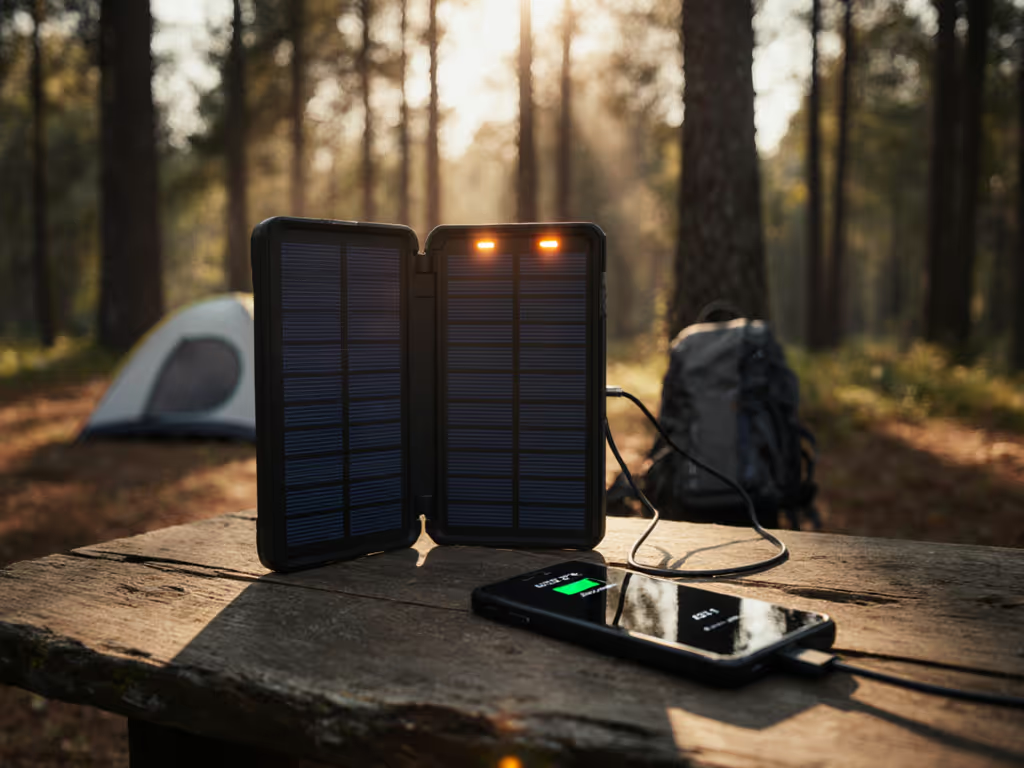
A solar power bank sits on a shelf promising "20W fast charging" and "wireless solar topping." You buy it for a two-week trek. Midway through, you're stuck with a half-charged device and a bank that won't move past 30% despite hours of sunlight. The spec sheet said 25,000 mAh. You've learned the hard way: real-world delivered capacity often falls 20-40% short, and claiming solar charging capability without measured efficiency data is like claiming a laptop won't brown-out under load without ever capturing its power negotiation trace.
In a lab engagement years ago, I watched a client's device keep rebooting whenever paired with what the vendor called a "PD-certified" bank. I clipped a sniffer inline, captured the PD trace, and found the contract bouncing erratically between 20V and 5V (a firmware bug never visible in marketing materials). That experience cemented a principle: if the PD log doesn't prove it, the claim doesn't count. Solar power banks live in the same space of unverified claims.
A solar power bank is a standard portable battery with photovoltaic cells bonded to its casing (nothing more).[2] The marketing term "solar power bank" creates false expectations; in practice, the solar panel is best viewed as an emergency or supplemental charging feature, not a primary power source.[2]
Internally, the design mirrors a traditional power bank: a lithium-ion or LiPo cell pack, a battery management system (BMS), and a charging controller. The solar addition introduces photovoltaic cells (typically amorphous or polycrystalline silicon) wired through a DC-DC converter to accept variable solar input (which ranges wildly depending on sunlight intensity, panel angle, and weather) and convert it to a regulated charging voltage.[1]
The honest reality: fully recharging a solar power bank using only its solar panels is impractical and often requires days of direct, uninterrupted sunlight.[2] This constraint is physics-based, not a design flaw. Small-form-factor solar panels (the kind that fit on a bank's casing without adding kilograms of weight) generate modest current under real-world conditions. Cloudy skies, oblique sun angles, and seasonal variation all degrade input further.
Searches for third-party testing reveal concrete numbers. The Blavor 10W, FlexSolar E10 Mini, and BigBlue SolarPowa 14 generated 1,401 mAh, 1,247 mAh, and 1,178 mAh of charge respectively in controlled outdoor testing.[4] Wh, not mAh, is the honest metric. If you assume a nominal 5V bus voltage (though many solar inputs vary), those figures translate to roughly 7 Wh, 6.2 Wh, and 5.9 Wh per charge cycle under test conditions.
Compare that to the bank's internal capacity (typically 10,000-30,000 mAh or 37-111 Wh at nominal voltage). A full solar recharge from empty would take weeks of incremental daily charging under ideal conditions. The solar panel is there for topping up a partially depleted bank or for emergency scenarios, not for primary charging workflows.
A solar panel's output is nonlinear with light intensity. Overcast skies can cut available power to 20-30% of peak sun; shadows, dust, and panel orientation angle (θ relative to the sun's position) multiply losses further.[1][6] Peak solar generation occurs only for a few hours around midday, and even then, the rate of charge depends heavily on sunlight intensity, panel size, efficiency, weather, and angle toward the sun.[2]
Measured real-world charging speed is extremely slow and unpredictable.[2] A bank left in a backpack with the solar panel facing downward will charge slower than one positioned toward direct sun. This variability makes it nearly impossible to guarantee delivery timelines based on solar input alone (a key contrast to wall-outlet charging, where input is standardized and predictable).
Every conversion stage introduces loss. Solar photons → electrical current (cell efficiency ~17-22% for consumer-grade panels), then through a DC-DC converter (85-95% efficient), then through the bank's BMS (97-99% efficient when idle). Multiply these: 0.20 × 0.90 × 0.98 ≈ 0.176, meaning roughly 18% of incident solar energy becomes usable charge in the internal battery under nominal conditions.[1]
Add thermal throttling in hot environments, resistance in thin charging cables, and voltage drop across poorly e-marked connectors, and delivered capacity shrinks further. This is why a bank rated at 25,000 mAh doesn't deliver 25,000 mAh of usable energy to your phone in field conditions. For a deeper breakdown of rated versus real capacity, see our mAh explained guide. Accounting for conversion losses, thermal derating in sun-exposed scenarios, and voltage sag during high-load discharge, realistic delivered capacity is often 15-25% lower than the nameplate figure. Show me the PD trace and the measured discharge curve under defined load, and I'll tell you what you'll actually get.
No. A standard power bank offers predictable and fast recharging, its charging speed is determined by the power output of its wall adapter.[2] Modern power banks with fast-charging technology can replenish a 10,000 mAh battery in as little as 2 hours when connected to a compatible USB-C PD charger.[2] To cut your bank’s self‑recharge time, follow our input wattage best practices.
In contrast, a full recharge from solar power alone can take many hours or even several days.[2] For professionals, travelers, and field workers who need reliable power within a defined time window, the solar feature is not a substitute for wall charging or a high-capacity bank pre-charged before the trip. It's an insurance policy (useful if you're stranded or if you want to squeeze another 5-10% into the battery while sitting in camp mid-afternoon).
Partially. If your phone is at 20% and you're in the middle of a hike with no outlet access, a solar-equipped power bank lets you trickle charge your phone while the bank itself tops up from ambient light. This concurrent dual-charging scenario is where solar shines.
But the cadence is slow. Under typical temperate overcast conditions, solar input might deliver 50-100 mA at 5V (0.25-0.5 W).[1] Charging a modern smartphone that draws 1.5-2 A at 5V (7.5-10 W) will still complete faster via USB connection to a standard bank than waiting for solar to both charge the bank and backfeed the phone.
Battery chemistry is temperature-sensitive. Lithium-ion cells lose capacity and charge rate efficiency in cold (<5 °C) and heat (>35 °C). A bank exposed to direct sun on a 35 °C day will experience BMS throttling to protect the cells, reducing output current and increasing charge time. Conversely, in alpine or winter camping scenarios, the same bank in a 0 °C environment will charge slower, discharge faster, and may trigger the BMS to cut output entirely if temperature sensors detect unsafe conditions.
Solar panels also lose efficiency in cold (though less dramatically than the battery itself). A bank left in a frozen backpack overnight might deliver only 60-70% of its nominal capacity when powered up at dawn, even if the solar panel is exposed to high-altitude clear skies. For quantified results across temperature ranges, see our cold weather efficiency data.
When reviewing solar power bank options, focus on measured performance rather than headline specs:
Delivered Capacity: Look for third-party testing or transparency about actual charge delivered to a device under standard conditions (e.g., discharging at 5V/2A until cutoff). Compare this to the nameplate mAh, gaps above 20% warrant skepticism.
Solar Panel Area and Efficiency: Larger panels capture more sunlight. Models with foldable designs and multiple cells generate significantly more than single-panel units.[3][1] Cross-reference the rated wattage output (e.g., "10W") with independently measured figures if available.
Multi-Port Capability: A bank with USB-A, USB-C, and potentially DC outputs offers flexibility for diverse devices.[4] Higher port count and simultaneous multi-device charging are valuable when managing phones, drones, and cameras in the field.
Charging Input Options: Check if the bank supports USB-C PD input for fast self-recharge. A bank that requires 8-12 hours to fill from a standard 5V/2A wall adapter is a liability during short layovers. USB-C PD input allows 20-60W charging, cutting bank recharge time to 1-3 hours depending on the charger and the bank's internal capacity.
Environmental Ratings: Waterproof, dustproof, and shock-resistant designs (IP67 or higher) are critical for outdoor scenarios. Banks with LED indicators and emergency light modes add utility without complexity.
Certification and Safety: Verify UN38.3, UL, or ETL markings. These third-party certifications indicate the BMS has been tested for thermal stability, short-circuit protection, and cell quality, reducing the risk of swelling or thermal runaway in the field.
Weekend Backpacking: A 10,000-15,000 mAh bank with solar is appropriate for 2-3 days if you pre-charge it fully before departure and rely on solar for opportunistic topping (afternoon camp breaks). The solar feature extends runtime by 10-15% in sunny weather, not by 50%.
Emergency Preparedness: A solar-capable bank is valuable in extended outages when wall power is unavailable. Paired with a larger capacity (20,000+ mAh), it serves as a slow but continuous trickle charger for critical devices (phone, emergency radio) over days without grid access. If preparedness is your priority, compare models in our emergency power bank tests.
Urban Travel and Short Trips: If you'll access outlets regularly (hotels, cafes, airports), the solar feature is marginal. Prioritize fast USB-C PD input and high capacity instead. A bank that recharges completely in 2-3 hours is more practical than one that charges slowly from both solar and USB.
Photography and Video: For field shoots requiring multiple device charges (camera, phone, backup battery), choose a bank with USB-C PD input and high watt-hour capacity. Solar is a bonus, not a primary strategy, because unpredictable charging timing disrupts shoot schedules.
A solar power bank rated at "25,000 mAh with 20W solar charging" doesn't deliver 25,000 mAh of usable energy to your devices in real-world conditions, nor will the 20W solar specification materialize under cloudy skies, oblique angles, or modest sunlight. Expect 60-80% of the rated capacity in delivered energy, and treat solar charging as a 10-15% runtime extension in good weather, not a primary charging method.
For time-sensitive scenarios, standard power banks with fast USB-C PD input remain the reliable choice. Solar power banks excel as supplemental insurance, a hedge against extended field time, camping trips, or preparedness scenarios where every available charging pathway improves resilience.
Choose based on measured delivered capacity (Wh, not mAh), multi-port flexibility, and fast USB-C input for self-recharge. Verify environmental ratings and BMS certification. And if anyone claims their solar bank can fully recharge in a day without direct sunlight, ask for the measured efficiency log. Specs alone won't survive contact with the real world.
To deepen your understanding, consider these next steps: