Product & Brand Comparisons
Anker Nano vs Xiaomi UltraThin: Which Compact Power Bank Is Better?
19th Jul•11 min read
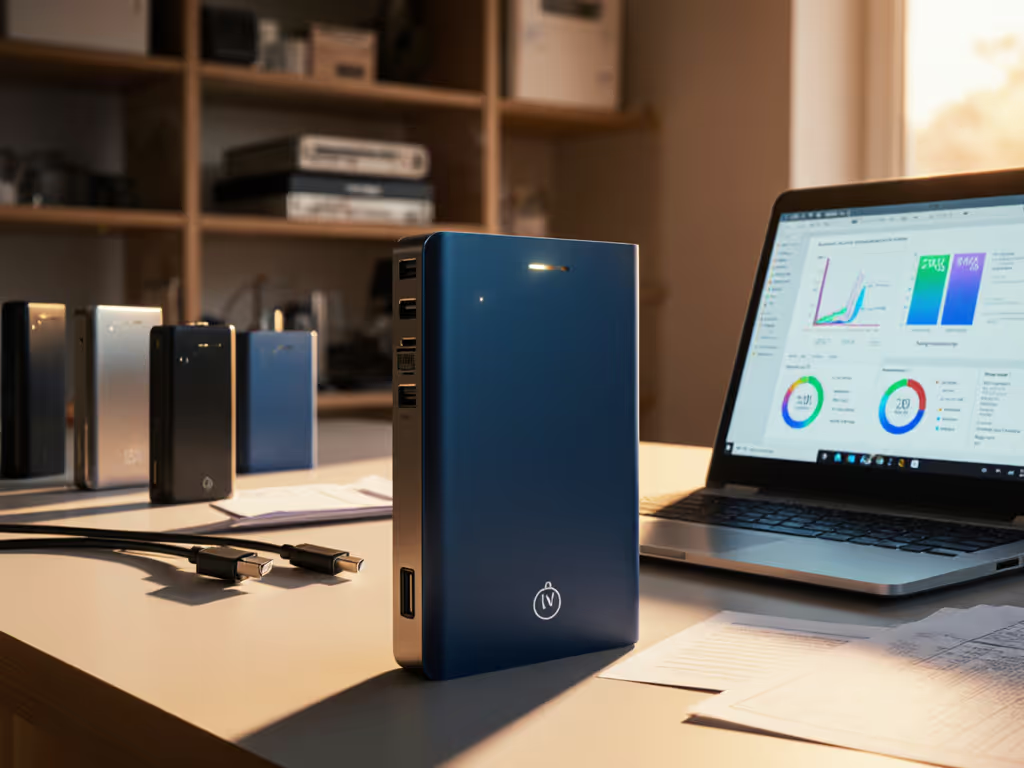
Fast charging power banks are everywhere, but their specs tell a misleading story. Milliamp-hours (mAh) and watts (W) are marketing units designed to look impressive on a box. What matters in your pack (what actually travels with you) is how much energy you get per gram of weight: watt-hours per gram (Wh/g) comparison. That ratio separates efficiency from hype.
I learned this the hard way. A friend bought a new phone and a "fast" 20,000mAh power bank, only to watch it trickle-charge at 10W when it promised 100W output. We swapped cables, and suddenly 45W appeared. But while diagnosing that, I also weighed the bank, and it was 60 grams heavier than it needed to be. That afternoon, I built a compatibility matrix and started documenting real Wh/g numbers, because the cable is a component, not an accessory (and neither is the weight you choose to carry).
Pair the cable right, but first, measure the bank itself.
Your power bank's sticker claims 20,000mAh or 100W. Your phone's battery is rated in watt-hours (Wh). Your pack's weight limit is measured in grams. Marketing doesn't want you thinking about all three together, but real efficiency demands it.
Watt-hours per gram (Wh/g) is the ratio of usable energy delivered to your devices divided by the weight you carry. A bank with 0.20 Wh/g is 25% more efficient than one rated 0.16 Wh/g, same capacity, less heft. Over a week-long trip or a year of daily carries, that difference compounds into real freedom.
Why does this matter?

The search for efficiency isn't vanity, it's preparation.
A 20,000mAh power bank doesn't deliver 20,000mAh to your phone. If you need a refresher on capacity math, see our mAh vs real capacity guide. Manufacturers use mAh because the number looks bigger. Here's the conversion.
Lithium cells are rated in both mAh (current × time) and nominal voltage. Most phone-sized banks use 3.6-3.7V nominal cells, or dual-cell packs at ~7.4V nominal.
Convert to Wh (the real measure) using this formula:
Wh = (mAh × Nominal Voltage) / 1000
For a typical 20,000mAh bank at 3.7V nominal:
But that's what's inside. Your USB-C output port will deliver significantly less due to:
Real-world rule: Expect 85-92% of advertised Wh to reach your devices. Use 87% as a conservative baseline.
74 Wh × 0.87 = ~64 Wh truly delivered
That 64 Wh is your working number for runtime planning, not the advertised 74.
A 45W output looks amazing on a spec sheet. But 45W means 45 joules per second. At 5V (USB default), that's 9 amps. At 20V (USB Power Delivery), that's 2.25 amps. The same power, very different current draw.
Low-voltage output (5V) burns more energy in the bank's internal components and generates heat faster. High-voltage negotiation (20V or higher via USB-PD) is far more efficient. But the cable must be e-marked (it has an embedded chip that negotiates the highest safe voltage for your device). Without one, your phone defaults to 5V, and you lose 15-25% of the promised power instantly. To avoid protocol mismatches, read our PD vs QC compatibility guide.
This is why compatibility is designed upstream. Choose the right cable, and 45W materializes. Choose wrong, and you get 15W trickle-charging, even though the bank is rated for 100W. Your Wh/g efficiency collapses in real time because that 64 Wh now drains over 4 hours instead of 1.5 hours.
This is where most articles vanish. Manufacturers hide weight in footnotes or omit it entirely because lighter isn't always better, it often means cutting corners on the BMS or enclosure.
Where to find it:
For reference, here's what current compact-to-mid-range models weigh, based on published specifications and industry testing:
| Model | Capacity | Stated Output | Estimated Weight | Notes |
|---|---|---|---|---|
| UGREEN Nexode 20,000mAh 130W | 20,000mAh (~74 Wh) | 100W per port | 200-220g (typical for class) | Fast PD input, multi-port |
| Anker MagGo (10K, Slim) | 10,000mAh (~37 Wh) | 140W via MagSafe | ~220g (MagSafe adds bulk) | Wireless alignment overhead |
| INIU P50-E1 (45W) | 10,000mAh (~37 Wh) | 45W USB-C | ~190-210g | Compact, efficient venting |
| Anker Prime | 27,650mAh (~97 Wh) | 140W single-port | ~500g+ | Laptop-tier, fast 250W input |
Notice the clustering: most consumer banks land between 0.15-0.19 Wh/g. That's not coincidence, it's the practical limit of current lithium chemistry, safety regulations, and BMS engineering.
Now the core formula:
Real Wh/g = (Advertised Wh × 0.87) / Weight in Grams
Example: A 20,000mAh bank (74 Wh nominal) weighing 210 grams:
That's good. Most clusters at 0.15-0.22 Wh/g.
Don't buy the "best" Wh/g in abstract. Buy the one that solves your specific problem without overengineering.
Target: 0.18+ Wh/g, total weight <200g.
Example: The INIU P50-E1 (45W, 10,000mAh, ~200g) delivers roughly 37 Wh and pairs efficiently with a single e-marked USB-C cable.
Real-world runtime for iPhone 15 Pro (12.2 Wh battery):
This is your pocket backup, not your primary bank for multi-day trips, but excellent for conference stays or urban exploration where an outlet is usually within a few hours.
Target: 0.17-0.19 Wh/g, 15,000-20,000 mAh, 100W+ output, fast input recharge.
Example: UGREEN Nexode 20,000mAh, 130W rated, 100W per port. Assuming 210g weight:
Critical protocol check: Confirm the power bank's USB-C output negotiates with your laptop's Power Delivery profile. A 100W output means nothing if your laptop requests 67W and the cable can't establish that negotiation. An e-marked USB-C cable eliminates this guesswork entirely.
Target: 0.16-0.19 Wh/g, 20,000-27,000+ mAh, 140W+ single-port output, 250W+ fast input.
Example: Anker Prime 27,650mAh. At ~500g weight:
Tradeoff: You're carrying a half-kilogram, but you get near-laptop-grade endurance and the fastest input recharge on the consumer market. Worth it for week-long international trips where outlets are sparse. To minimize downtime between flights, follow our power bank recharge speed guide.
Target: 0.15-0.18 Wh/g, prioritize active venting and BMS thermal management over peak density.
Lithium cells lose 30-50% capacity below 0°C. A bank rated 37 Wh at room temperature delivers only 18-26 Wh in freezing conditions. See our cold-weather efficiency data to estimate real runtime by temperature. Some banks include insulated sleeves, carry one if you're in snow, high altitude, or extended cold missions.
Avoid: Ultra-thin banks (<10mm) without internal copper plates or venting. They throttle hard in sub-zero and overheat dangerously in direct sun.
This is where compatibility beats Wh/g. A 0.20 Wh/g bank locked into 5W USB mode is useless; a 0.16 Wh/g bank negotiating full 45W USB-PD is gold.
Before you buy, confirm these four things:
1. Your device's native charging speed (from the manufacturer):
2. The power bank's maximum output per port: Some banks claim 140W total but only 65W on any single USB-C port. Read the fine print for "max single-port output," not aggregate.
3. Protocol support:
A single bank should support all three for ecosystem flexibility.
4. Cable compliance: Your cable must be e-marked (embedded chip that negotiates voltage/current safely). Without one, even a 140W bank will default to 5V output, and your real charging wattage plummets from 45W to 15W in seconds.
Pair the cable right, or the bank's power density doesn't matter.
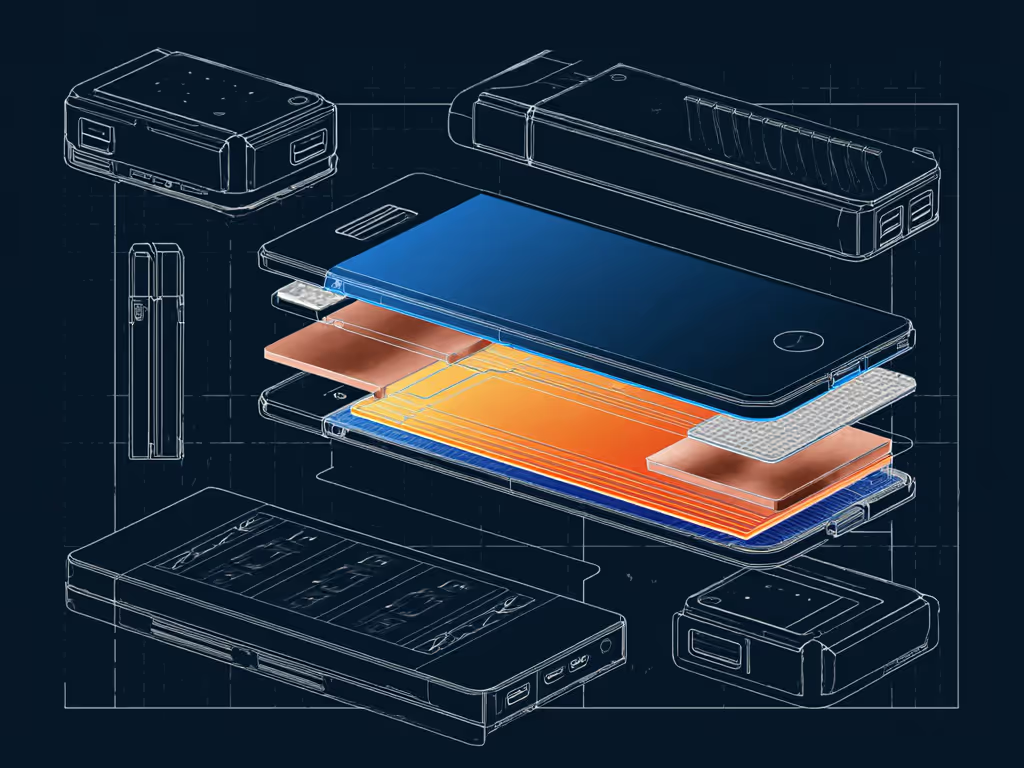
High Wh/g sometimes means higher internal density, which traps heat. Under continuous 45W+ output, some banks throttle after 15-30 minutes, dropping from 45W to 20W as the BMS protects itself.
What to look for:
A 0.18 Wh/g bank with active thermal design often outperforms a 0.22 Wh/g unit with passive cooling in real multi-device, multi-hour use.
Here's the framework for choosing your bank:
| Scenario | Capacity Range | Weight Target | Wh/g Goal | Priority | Key Consideration |
|---|---|---|---|---|---|
| Day trip / urban | 10-15K mAh (37-55 Wh) | <200g | 0.18+ | Portability | Pocket-sized; single full charge |
| Conference / business | 15-20K mAh (55-74 Wh) | 200-220g | 0.17-0.19 | Speed + capacity | 45W+ output; e-marked cable |
| Extended travel | 20-27K mAh (74-97 Wh) | 400-500g | 0.16-0.19 | Capacity + recharge speed | 140W output; 250W input; multi-device |
| Winter / rugged | 15-20K mAh (55-74 Wh) | 250-280g | 0.15-0.17 | Thermal headroom | Active cooling; BMS throttle curves |
You'll notice no honest consumer bank exceeds 0.22 Wh/g. That's not a limitation, it's physics and safety.
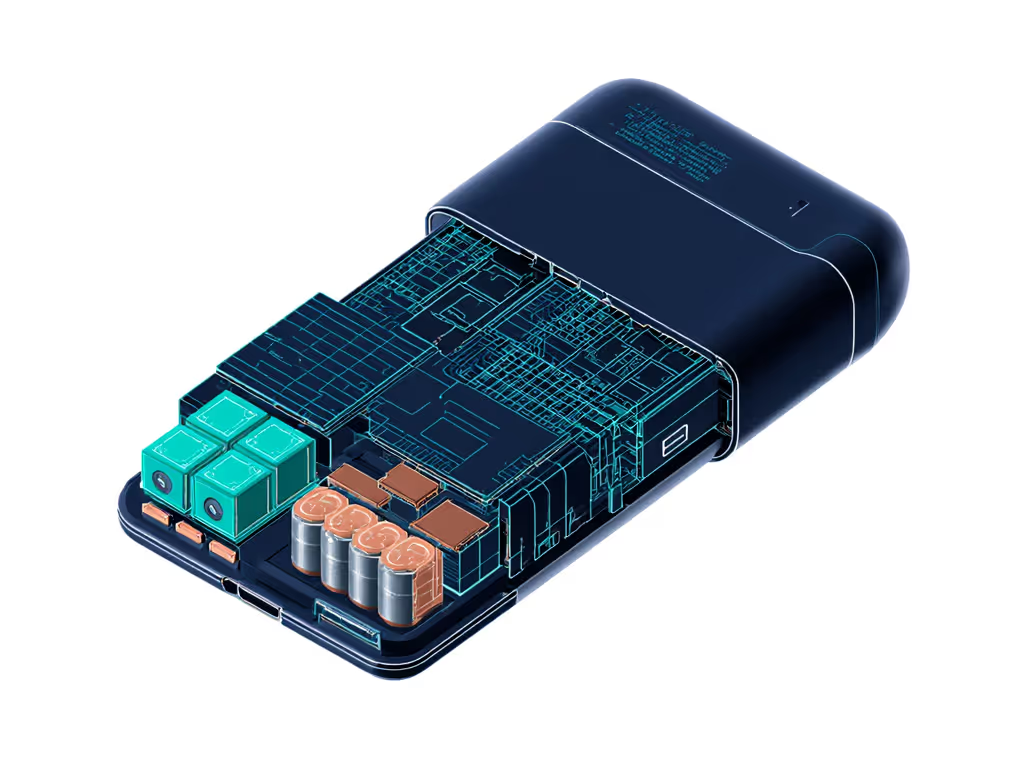
Modern lithium cells theoretically deliver 250-300 Wh/kg at the cell level. But add a protective enclosure (5-10g), battery management system (15-25g), USB ports and internal wiring (8-15g), and thermal interface materials (5g), and you immediately lose 20-30% of mass to infrastructure. Then apply the 87% delivery efficiency rule, and the ceiling drops further.
Result: 0.15-0.22 Wh/g is the realistic range for any safe, compliant bank with proper BMS and certifications. Anyone claiming 0.25+ is either using lab-grade cells in limited production, underspecifying the actual BMS, or inflating the mAh rating. Treat such claims with extreme skepticism.
Trap 1: Comparing mAh Across Different Nominal Voltages A 30,000mAh bank at nominal 3.6V and a 15,000mAh at 7.4V (dual-cell pack) store identical energy. Don't get fooled by the headline number, always convert to Wh.
Trap 2: Ignoring Conversion Losses A bank's advertised 100W output assumes perfect conversion. At 87% real efficiency, that's 87W delivered. Always demand real-world benchmarks under sustained load, not peak burst specs.
Trap 3: Skipping Airline Compliance Banks over 100 Wh are restricted or banned on many airlines. Check your carrier's battery limits before optimizing a high-capacity bank for your route. For detailed rules and recommended models, see our airline compliance guide.
Trap 4: Assuming All "Fast Chargers" Deliver the Same Speed A 45W output rating means zero without protocol support. Confirm USB-PD 3.1, PPS, or QC compatibility for your ecosystem. A wrong cable, and you get trickle-charging despite the rated wattage.
Trap 5: Buying Purely by Wh/g The most efficient bank is worthless if it doesn't charge your devices at the speed you need. Balance density with real-world compatibility and thermal headroom.
Now that you understand Wh/g and what drives real efficiency, execute this sequence:
Compatibility is designed upstream. Choose the right cable and negotiate the right voltage, and power density becomes predictable. Pair the cable right, and your bank's Wh/g efficiency reaches your devices, every joule counts.