Technical Basics, Safety & Care
Real-World Power Bank Capacity: mAh to Device Charges
10th May•9 min read
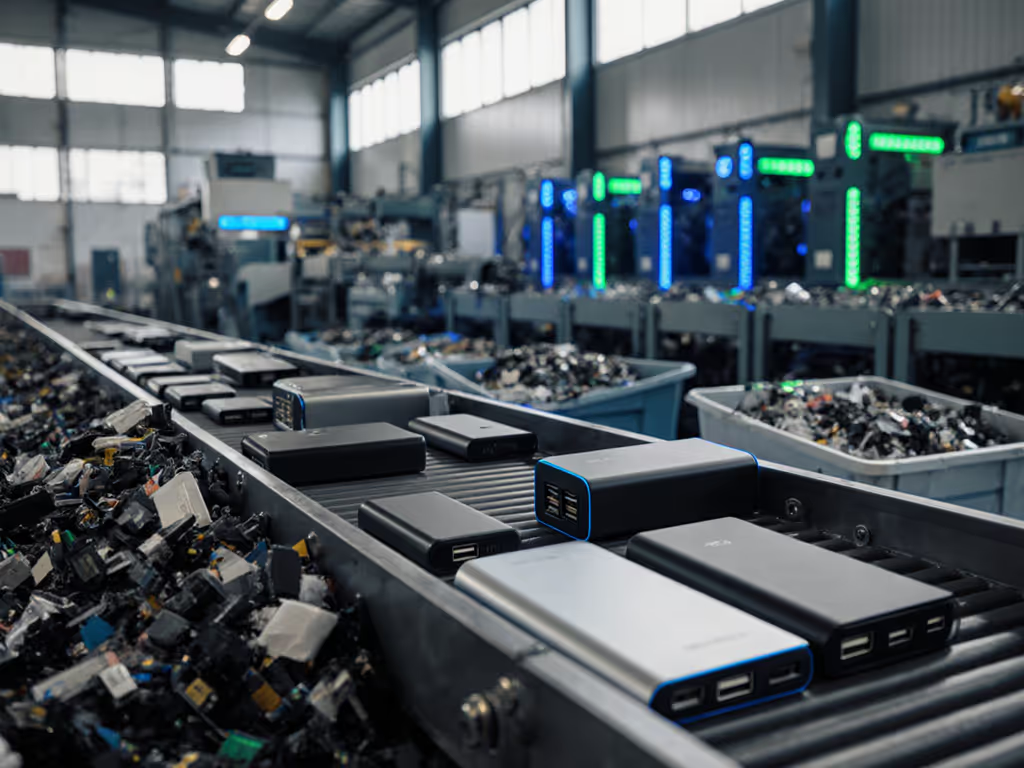
The power bank environmental impact goes far beyond the moment a device stops holding charge. When a power bank (or any device containing lithium-ion battery cells) ends up in a landfill instead of entering a proper sustainable power bank disposal pathway, it triggers a cascade of environmental and public health consequences that most users never see. Yet the decision to recycle or discard is one of the highest-leverage choices you'll make with your gear. Understanding what actually happens upstream in recycling, and the alternative costs of mining and extraction, gives you the data you need to make a predictable, informed choice.
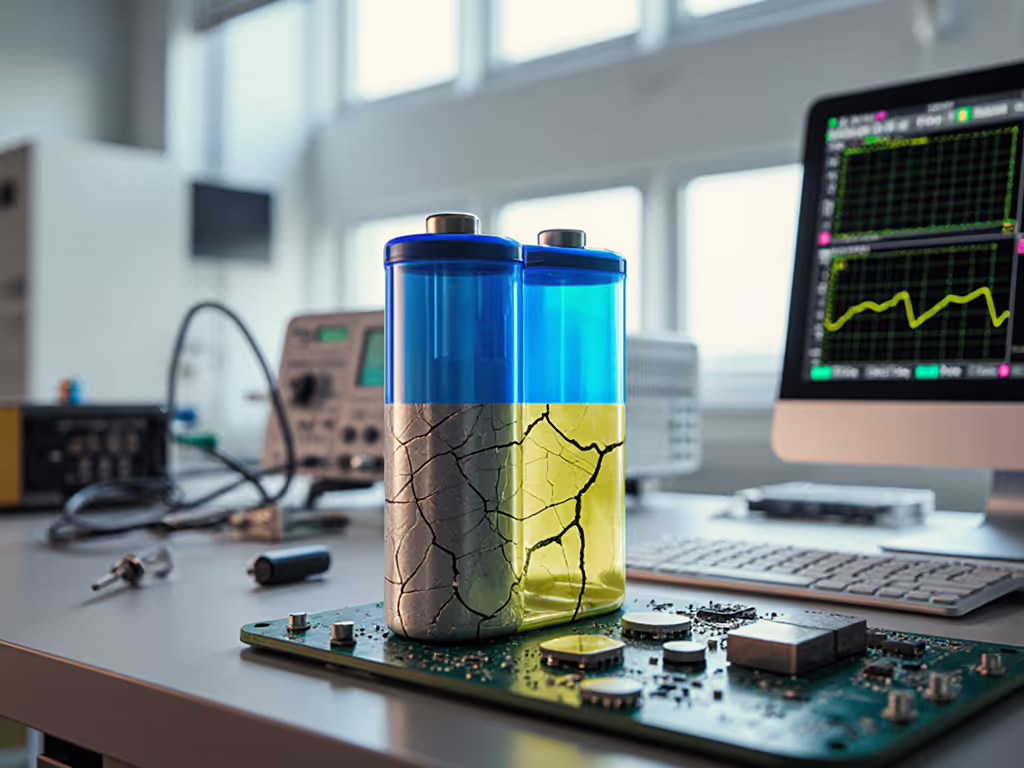
Most power banks end up in landfills. In the United States alone, less than 5 percent of devices containing lithium-ion batteries are recycled, despite the fact that consumers discard hundreds of millions of electronics annually.[5] When a power bank sits in a landfill, its cells will eventually corrode and decay, releasing dangerous chemicals into the environment, including battery acid and heavy metals such as cobalt, nickel, and lithium.[1] These toxins seep into soil, groundwater, and surface water, creating long-term contamination that harms both ecosystems and human health.[4]
The hazard is not theoretical. A study from Australia found that 98.3 percent of lithium-ion batteries end up in landfills, which increases the likelihood of landfill fires that can burn for years.[3] When uncontrolled fires spread through mixed combustible waste (cardboard, plastic, foam), the heat becomes extremely difficult to manage, and toxic fumes enter the air.[4]
Understanding the environmental cost of mining makes recycling's value unmistakable. About 40 percent of the carbon footprint from lithium-ion battery production comes from mining and processing the minerals needed (lithium, cobalt, nickel, and manganese).[3] Mining and refining these materials is energy-intensive, which is particularly costly in regions like China, which dominates the world's EV battery supply chain and generates almost 60 percent of its electricity from coal.[3]
In total, production of the average lithium-ion battery uses three times more cumulative energy demand compared to a generic battery.[3] To reduce upstream impact when you do buy new, consider our eco-friendly power banks guide. The extraction itself carries social and environmental costs that recycling sidesteps entirely: forced labor, dangerous working conditions, surface and groundwater depletion, soil contamination, biodiversity loss, and disruption to local economies.[2]
Recycling avoids all of that. Researchers at Stanford University found that recycling lithium-ion batteries produces less than half the greenhouse gas emissions and uses fewer resources than mining virgin material.[8] The battery materials themselves (copper, aluminum, lithium, cobalt) can be recovered, refined, and reused endlessly without depleting natural reserves or expanding the footprint of extraction sites.[1]
The numbers are striking. A recent analysis accounting for triple-bottom-line economics (environmental, social, and financial impact) shows that battery recycling in the United States can generate $11.3 billion to $40.3 billion in total economic value across market scenarios.[2] Even more compelling: social and environmental benefits alone contribute a net present value of $13.5 billion to $14.4 billion by 2040 (enough to offset negative profit pools even in a low metal price scenario).[2] This means recycling is environmentally justified regardless of market volatility.
The environmental and social value is the engine. When you recycle a power bank, you're not just diverting waste; you're funding the recovery of materials that will be used in new batteries for electric vehicles, renewable energy storage, and consumer electronics, reducing both mining pressure and the embedded emissions of new production.
To ensure your power bank is recycled responsibly, follow these practices:
A circular battery economy (one in which end-of-life batteries are repurposed, reused, or recycled) strengthens the entire clean energy supply chain.[2] Recovered lithium, cobalt, nickel, and copper are refined back into cathode powder and cell components, reducing reliance on virgin mining and ensuring a stable domestic supply of critical minerals needed for electric vehicles and renewable energy storage.
This is where predictable negotiation beats luck. When recycled material flows back into production, manufacturers can rely on a stable, domestic source of high-purity materials. That reliability upstream (from supply chain to design to performance) is what enables the batteries in your next power bank to charge faster, last longer, and weigh less than devices built with less certain sourcing.
Even when batteries are collected for recycling, the process itself carries hazards if executed poorly. Recycling lithium batteries requires careful handling: cutting too deep into a cell or in the wrong place can result in it short-circuiting and igniting.[3] Accidental or improper incineration can release toxic fumes into the air.[4] However, certified recyclers use controlled mechanical, thermal, and chemical processes to safely extract materials while minimizing emissions and contamination.
The key is using a certified recycler, not attempting informal or unvetted pathways. Look for facilities certified to ISO 14001, those holding UN38.3 battery handling certification, or companies that publish transparency reports on their recovery rates and emissions impact. Verification matters.
Recycling is one pathway, but reuse extends a power bank's environmental life even further. If you're replacing a unit, our repairable power banks guide helps you pick models built to last and reduce future e-waste. If your power bank still holds 60-80 percent of its original capacity, it may be suitable for refurbishment and resale, a second life that delays mining and manufacturing of a replacement device by several years.
Before recycling, ask yourself:
If yes, donate, sell, or gift it. If no (or if the battery is visibly swollen or unresponsive), recycling is the responsible path forward.
Predictable negotiation beats luck. When you send your power bank to a certified recycler, you're not gambling on environmental outcome; you're ensuring that materials flow into a known, measured pathway. You're also signaling to manufacturers and retailers that circular design matters (that durability, repairability, and end-of-life recovery are features worth engineering for).
Start by identifying a certified e-waste recycler in your region or check whether your power bank's manufacturer offers take-back programs. Document the facility's certifications (ISO 14001, UN38.3) and recovery transparency. Then, at the end of your device's life, use that pathway. One decision, multiplied across your household and workplace, shapes the supply chain upstream.
If you'd like deeper technical details on battery chemistry, carrier-specific airline compliance rules for power banks, or data on which recyclers process the highest recovery rates by material, explore local environmental agency resources, the EPA's battery recycling guidance, and manufacturer sustainability reports. Your due diligence upstream (in choosing recycling and verifying the processor) determines the predictability of impact downstream.