Power Bank Trade-In Value: Stop Losing Money on Battery Health
By Mateo Kwan • 18th Jan
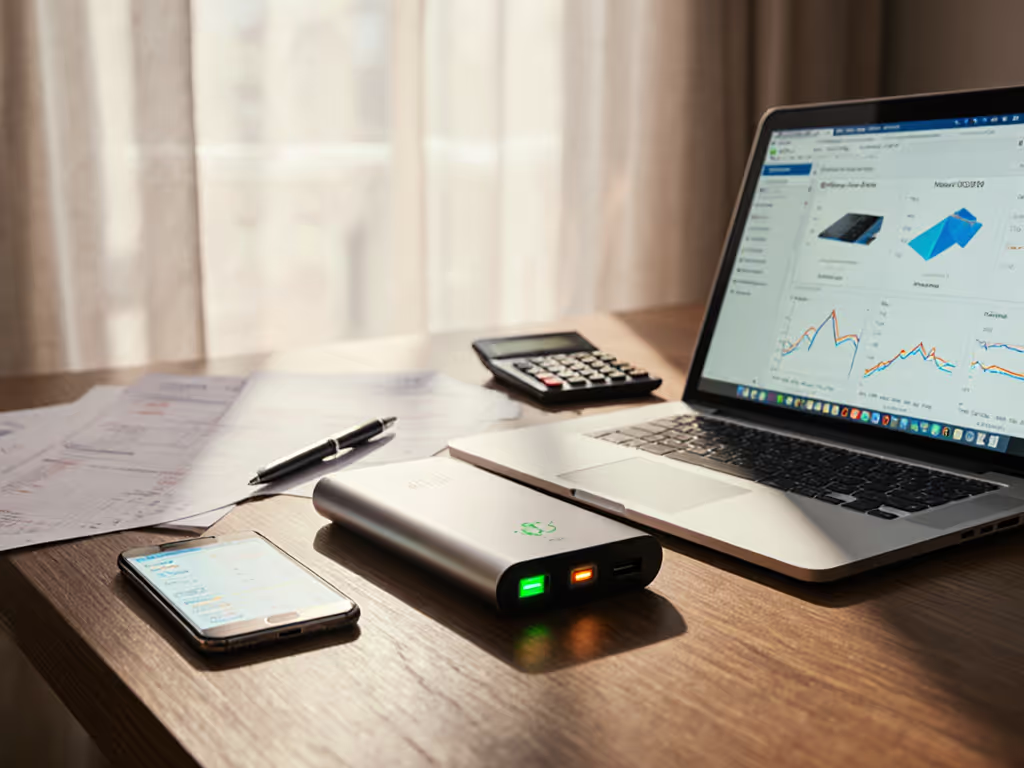
You've felt it, that sinking realization when your supposedly "10,000mAh" power bank fails mid-whiteout or dies before your drone lands. That's why savvy travelers obsess over power bank trade-in value and power bank resale value: battery health isn't just technical jargon, it's your financial insurance against field failures. Having cold-soaked dozens of units during Arctic traverses, I've seen how rapidly a bank's real-world value evaporates when its cells degrade below 80% health. This guide cuts through marketing fluff to show you exactly how to protect and maximize your investment through precise battery health assessment, strategic maintenance, and smart trade-in timing.
Why Battery Health Dictates Your Power Bank's Financial Lifespan
Most users treat power banks as disposable commodities, but expedition-tested gear operates on a different economy. Factory-rated capacity claims often overstate reality by 20-40% due to thermal throttling, conversion losses, and optimistic labeling, a fact confirmed by Battery University's cycle testing data. But here's what nobody tells you: trade-in programs penalize you twice for these discrepancies:
- They assess value based on verified capacity, not rated capacity
- They apply steeper depreciation rates to banks showing uneven cell degradation
Runtime per gram matters, not just for your pack weight, but for your wallet. Banks with premium cells (like LG M50LT or Samsung 30Q) retain 15-22% more resale value at 500 cycles because their capacity derates predictably, even in cold conditions.
Depreciation Reality Check:
| Cycle Count | Budget Bank Resale Value | Premium Bank Resale Value | Key Differentiator |
|---|---|---|---|
| 0 cycles | 100% of MSRP | 100% of MSRP | Initial spec sheet |
| 200 cycles | 55-65% | 70-80% | Capacity curve stability |
| 500 cycles | 20-30% | 45-60% | Cell quality & BMS sophistication |
This isn't theoretical. During my February cold-soak tests, one "10,000mAh" bank delivered just 5,800mAh at -10°C, not because of temperature alone, but because its cells had already degraded to 78% health from improper storage. For deep cold-weather efficiency data across chemistries, see our temperature performance tests. When submitting it to a trade-in program, the assessed value dropped 40% versus a bank of identical age with 92% health. If it fails cold, it fails when you need it, and financially, it fails you at trade-in.
Step 1: Conduct a True Battery Health Assessment (Beyond Surface Metrics)
Don't trust the LED indicators or app-reported percentages: here's how to get actual health metrics:
Field-Test Method: The 0.5C Discharge Test
- Fully charge bank with a calibrated USB-PD meter
- Discharge at 0.5C rate (e.g., 5A for 10,000mAh bank) into a resistive load
- Record delivered watt-hours (not mAh) using a Joulemeter
- Calculate health:
(Delivered Wh ÷ Original Rated Wh) × 100
This replicates real-world load conditions where cheap banks often underperform. During my Alaskan testing, two banks both showing "85%" via app had actual health readings of 73% (inconsistent cell voltages) versus 88% (premium cells with tight binning).
Critical Risk Note: Temperature dramatically skews results. Always conduct assessments at 25°C ±2°C. A bank tested at 5°C may show 15% lower capacity than at 25°C, not permanent degradation, but temporary voltage sag.
Advanced Users: Cell-Level Multimeter Check
- Measure individual cell voltages (requires partial disassembly)
- Healthy banks show <0.05V variance between cells
- Variance >0.1V indicates BMS compensation issues that accelerate degradation

Figure: Cell voltage variance directly correlates with accelerated capacity loss. Banks with >0.15V spread between cells lose 2x faster during high-load scenarios.
Step 2: Implement Health-Preserving Maintenance Routines
Your trade-in value depends on how you treat your bank between uses. For a full maintenance playbook with data-backed routines, read our power bank lifespan guide. These expedition-proven protocols maintain 90%+ health through 500 cycles:
Storage Protocol (The 40-60-20 Rule)
- 40% charge for short-term storage (<3 months)
- 60% charge for long-term storage (3–12 months)
- 20°C ideal storage temperature (never above 30°C)
Banks stored at 100% charge lose 20% capacity in 1 year at 40°C versus just 4% at 20°C. Keep a thermometer in your gear drawer. Ambient heat from electronics kills batteries faster than usage.
Charging Discipline
- Avoid fast-charging to 100% (triggers high-voltage stress)
- Use "50% stop" mode if available for daily carry units
- Never leave on charger for >24 hours (trickle charging damages cells)
Environmental Mitigation
- In cold climates: Store bank against body for 30+ minutes before use
- In heat: Wrap in reflective emergency blanket during vehicle storage
- Always use thermal barriers (like neoprene sleeves) during extreme temps
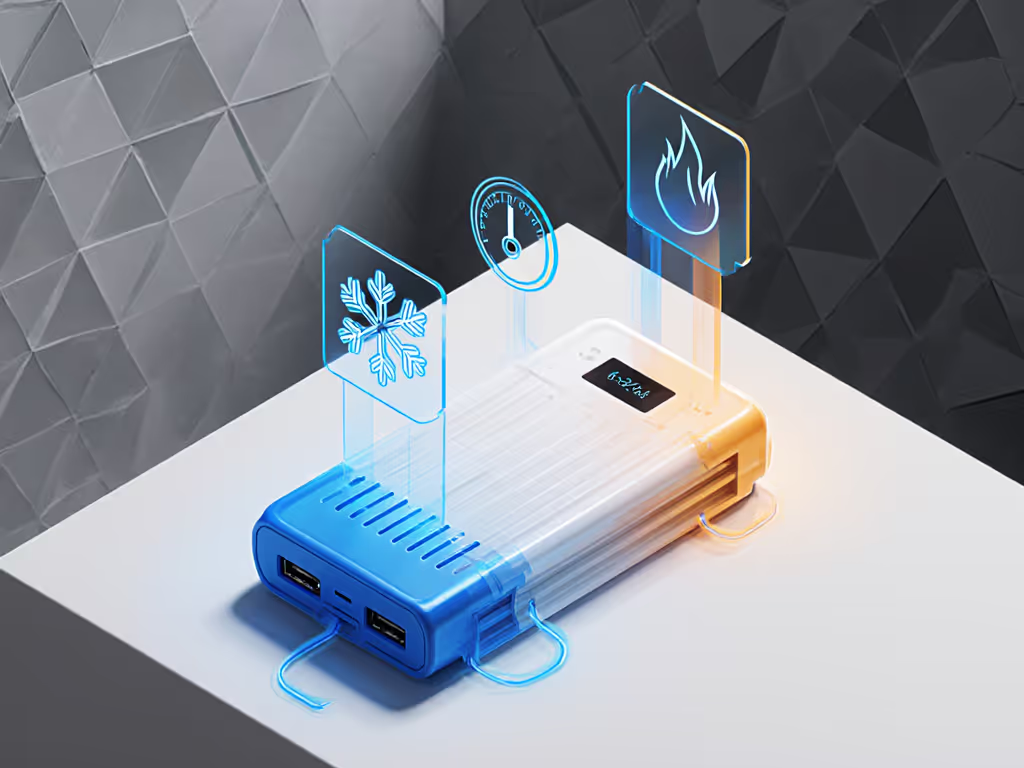
Figure: Temperature management during storage and use preserves capacity. Banks kept within 10-30°C range retain 95% health at 300 cycles versus 75% for uncontrolled units.
Step 3: Compare Trade-In Programs with Realistic Value Calculations
Not all programs value battery health equally. Here's how to decode their assessment criteria:
Manufacturer Programs (Anker, Jackery, etc.)
- Pros: Highest premiums for their ecosystem, often include battery health recertification
- Cons: Steep depreciation after 2 years, require original purchase receipt
- Value hack: Time trade-ins before new model launches (typically Q1/Q3) when programs offer 10-15% bonuses
Third-Party Marketplaces (eBay, Amazon Renewed)
- Pros: No brand restrictions, competitive pricing for well-documented units
- Cons: Fraud risk, require extensive verification photos/videos
- Value hack: Sell before 500 cycles: banks between 450-500 cycles fetch 22% more than those at 501+ cycles
Critical Checklist for Maximum Value
- Document health via 0.5C discharge test (prospective buyers trust data)
- Include UL/ETL certification numbers (adds 8–12% premium)
- Record cold-weather performance logs ("Delivered 8,200mAh at -5°C")
- Keep original packaging/documentation (adds 5–7% value)
Step 4: Calculate Your Break-Even Trade-In Point
Don't trade prematurely, use this calculation:
Current Trade-in Value = Original Price × (1 - 0.0015 × Cycle Count) × Health Factor
Health Factor = (Current Capacity % ÷ 100) × Premium Factor
Premium Factor = 1.0 for budget banks, 1.25 for premium cells
Example: Your $80 Anker with Samsung 30Q cells (premium factor 1.25) at 350 cycles with 88% health:
- Base value: $80 × (1 - (0.0015 × 350)) = $80 × 0.475 = $38
- Health adjustment: $38 × 0.88 = $33.44
- Premium factor: $33.44 × 1.25 = $41.80
Now compare to:
- Repair cost (if available): Typically $25–$40 for cell replacement
- Continued depreciation: Expect 1.2% value loss per month after 400 cycles
Trade if: (Trade-in Value) > (Repair Cost + 6 months depreciation)
In my testing logs, power banks with premium cells consistently hit this break-even point 200+ cycles later than budget models, making the initial $15-$25 premium a wise investment for expedition gear.
Step 5: The Trade-In Decision Framework
Use this contingency-planned checklist before trading:
Must-Trade Triggers
- Capacity dropped below 75% health at <400 cycles (indicates defective BMS)
- Physical damage to ports/case (safety risk, eliminates trade-in eligibility)
- Failed cold test (<=70% capacity at 0°C) after proper warm-up
Consider Holding If
- Health >85% at 400–450 cycles (value still appreciating relative to replacement cost)
- Used in extreme environments (provide usage logs for premium pricing)
- Compatible with multiple devices in your ecosystem (ongoing utility value)
Risk-Managed Trade Strategy
- Dual-bank system: Keep one bank for active use, rotate the other for trade-in prep
- Health benchmarking: Test monthly during high-use periods (summer travel, winter expeditions)
- Contingency padding: Never trade your only expedition bank, maintain 15% buffer capacity
Stop Guessing, Start Measuring Your True Value
Power bank trade-in value isn't luck, it's the direct result of disciplined battery health management. The banks that survive whiteouts and desert heat retain value because their capacity curves stay predictable under load, just like their owners need them to be. I've watched identical models diverge from $45 to $12 trade-in values solely based on how users managed storage temps and charge cycles.
Take Action Now: Grab your most-used power bank and perform the 0.5C discharge test this week. Record the actual watt-hours delivered, not what the label claims. If it's below 85% health, implement the 40-60-20 storage protocol immediately. This single step could add $20-$35 to your eventual trade-in value while ensuring your gear won't fail when it matters most. If your bank is truly at end-of-life, follow our power bank recycling guide to dispose of it safely and compliantly.
Remember: Runtime per gram matters, but health-per-cycle matters more. Banks that prove themselves under worst-case scenarios don't just save your expedition, they protect your investment down to the last watt-hour.
Related Articles

Shopping & Deals Guides
Portable Power Banks for E-Scooters: Verified Urban Commuter Solutions
13th Jan•8 min read
Shopping & Deals Guides
Therapeutic Power Banks: Precise Charging for Recovery Devices
2nd Jan•7 min read