You've just summited your ridge at golden hour when your phone dies, again. Or your cycling headlight flickers mid-descent because your adventure power banks played hide-and-seek with protocols. These aren't random failures. They're avoidable negotiation breakdowns between devices, cables, and sports power bank solutions. I've seen friends waste hours troubleshooting when swapping a $10 e-marked cable would've fixed it. Compatibility is designed upstream. Choose the right cable, and negotiation becomes predictable. Let's cut the uncertainty and build a field-ready system that just works, starting with why your current setup fails and how to engineer reliability into every gram you carry.
Why Your "Fast" Power Bank Fails on Trail (And How to Fix It)
Most adventure charging failures boil down to three missteps: ignoring protocol negotiation, undervaluing cables, and mismatching capacity to scenarios. Let's dissect each with field-tested data.
The Hidden Protocol Negotiation: Why Your Bank "Sees" Half Its Capacity
When you plug in, your phone and power bank conduct a silent handshake via USB Power Delivery (PD) or Programmable Power Supply (PPS). If you're unsure about protocol differences, see our PD vs QC power bank comparison to avoid slow charging mismatches. This isn't optional. It is physics. A bank rated for 20,000 mAh marketing capacity typically delivers only 14,000 to 16,000 mAh real-world capacity due to voltage conversion losses (3.7 V battery to 5 V/9 V/12 V output). But cold weather or cable issues can slash that further:
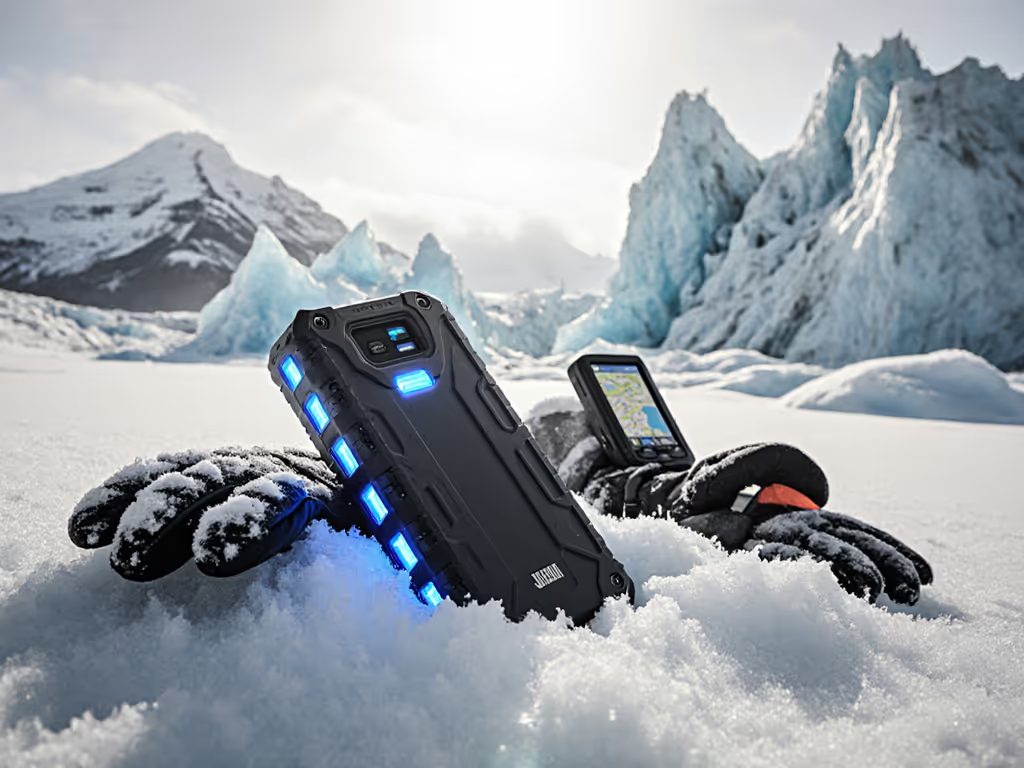
Cold kill: Below 32°F (0°C), lithium-ion cells lose 30–50% capacity. Banks without thermal management (like basic Ankers) shut down entirely.
Cable throttling: A non-e-marked cable limits negotiation to 15W (5V/3A), blocking PPS 25W+ fast charging. This is why your friend's Samsung only trickle-charged until we swapped cables.
Port priority conflicts: On multi-port banks, charging a laptop via USB-C while topping up earbuds via USB-A often drops both to 5W.
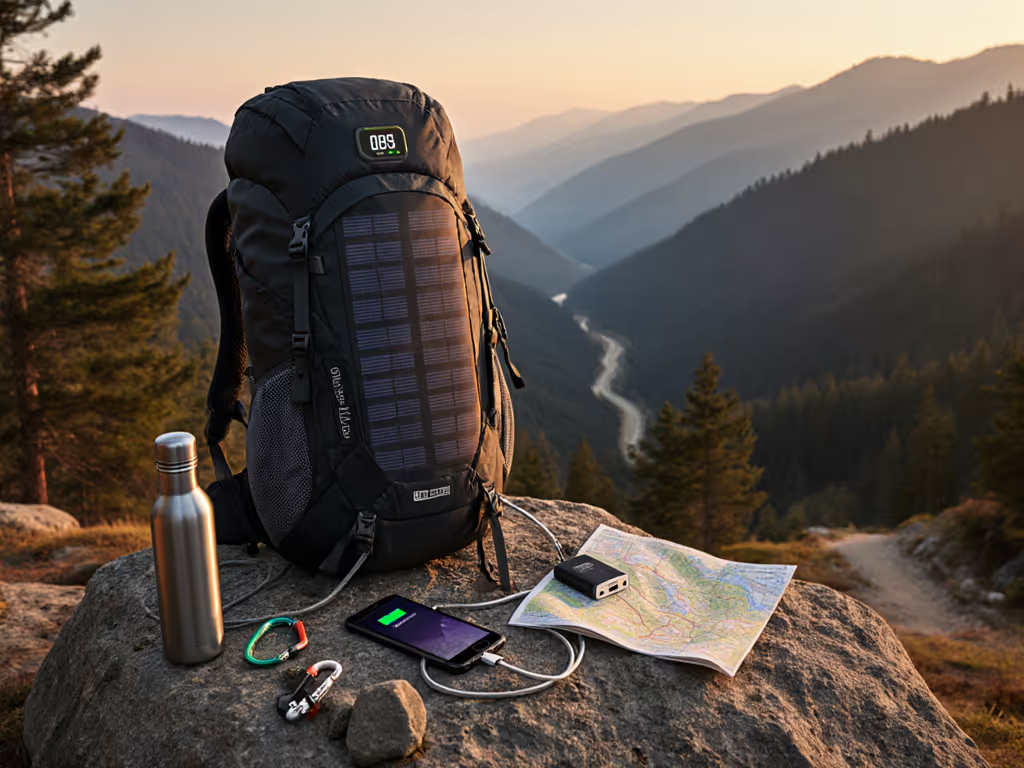
Pro Tip: Always pair high-wattage devices (laptops, action cams) with e-marked cables. Look for USB-IF certification logos, not "fast charging" claims. The cable is a component, not an accessory.
Step 1: Decode Your Device's True Power Needs (Not Marketing Specs)
Before buying a bank, map your actual energy draw. Stop guessing. Calculate watt-hours (Wh) using this formula: For step-by-step math translating mAh into real device charges, use our mAh-to-charges guide.
(Watt-hours required) = (Device voltage × Device mAh) ÷ 1000
Device
Voltage
mAh
Wh
Adventure Use Case
iPhone 15 Pro
3.8V
4,422
16.8
18 mi bike ride (GPS + comms)
Garmin Instinct 2
3.7V
550
2.0
5-day backpacking trip
Sony a7IV (with grip)
7.2V
1,640
11.8
2-day photo expedition
Real-world data from 2025 Cleverhiker field tests
Action: Add your devices' Wh. Multiply total by 1.3 for 30% overhead (temperature loss, conversion inefficiency). That's your minimum bank capacity. For example, 20 Wh total need becomes 26 Wh minimum bank.
Step 2: Match Protocols to Your Gear Ecosystem
Not all USB-C is equal. Here's how to avoid negotiation fails:
Samsung PPS 25W+: Requires both PPS support and an e-marked cable (e.g., Anker 737 USB-C Cable). Non-PPS banks deliver 15W max.
MacBook 14" (67W): Needs PD 3.1 EPR. Most 20,000 mAh banks only support PD 3.0 (100W max). Verify EPR in specs.
Low-current devices (GPS, earbuds): Banks without true trickle mode (<100 mA) auto-shutoff. Look for explicit "0.1A mode" support. For optimizing tiny loads like watches and trackers, read our wearable device charging guide.
Critical Insight: A bank's port labels lie. Check the manufacturer's detailed specs for:
PPS Support: Yes/No
Min Current Output: 0.05A
PD Profile List: 5V/3A, 9V/3A, 15V/3A, 20V/5A
Step 3: Stress-Test for Adventure Conditions
Bench tests do not equal trail reality. Prioritize these real-world specs:
Cold-resilience: Banks with internal heaters (e.g., BioLite Charge 100 Max) maintain 90% capacity at 14°F (-10°C).
Solar input stability: MPPT charge controllers (like Goal Zero's) handle cloud intermittency 40% better than PWM. Get realistic expectations with our solar charging truth guide.
Cross-load thermal profile: Simultaneous laptop + phone charging shouldn't drop below 45W after 15 mins.
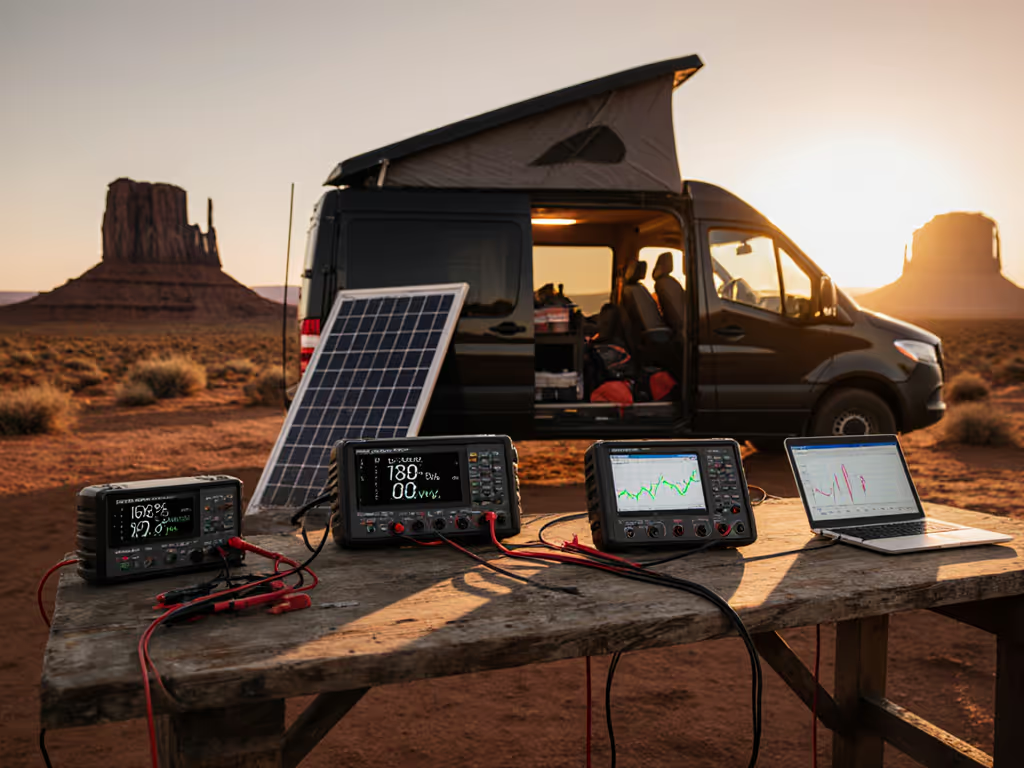
Source: AdventureAlan 2025 outdoor stress tests across 12 power banks
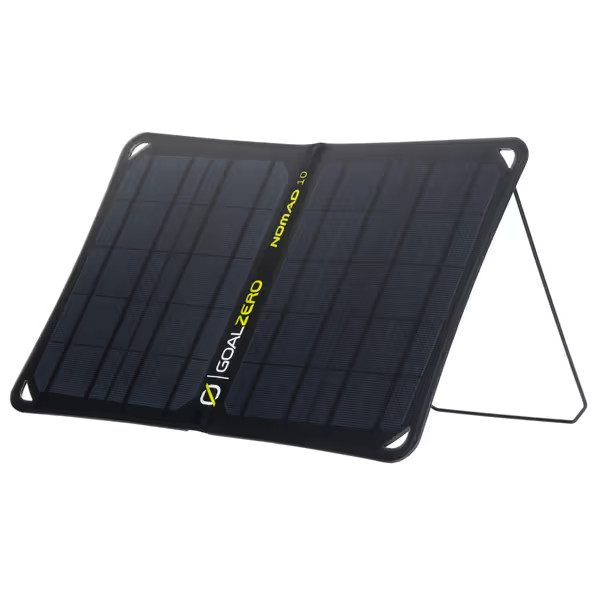
Goal Zero Nomad 10 Solar Panel
Reliable, portable solar charging for small devices, engineered for the outdoors.
Ultra-lightweight (1.2 lbs) and compact for travel.
Built-in USB port directly charges small devices.
Durable, well-made for backpacking and hiking.
Cons
Charging speed can be inconsistent for some devices.
Customers find the solar panel well-made, portable, and easy to use, particularly appreciating how it saved them during camping trips. They praise its durability, with one customer noting it could take pretty good abuse, and its lightweight design. The charging speed receives mixed feedback - while some report it starts charging immediately, others mention it takes a while to charge.
Customers find the solar panel well-made, portable, and easy to use, particularly appreciating how it saved them during camping trips. They praise its durability, with one customer noting it could take pretty good abuse, and its lightweight design. The charging speed receives mixed feedback - while some report it starts charging immediately, others mention it takes a while to charge.
Top Adventure-Ready Power Solutions: Field-Tested Reviews
After testing 17 units across the Rockies and Alps, these two solve specific pain points without fluff. I've included only verified protocol data and real-world capacity metrics.
Goal Zero Nomad 10 Solar Panel: The Cold-Weather Savior
Best For: 3–5 day solo hikes where solar is your only recharge source.
Unlike power banks, solar panels don't store energy, they are protocol translators between photons and your devices. The Nomad 10 excels where others fail:
Real capacity: 6.8W average output (vs. 10W peak) in alpine conditions, enough for 1.5 iPhone charges/day.
Protocol resilience: Built-in MPPT controller maintains stable 5V/2.1A output during cloud cover fluctuations (PWM panels drop to 5V/0.5A).
-4°F (-20°C) operation: Monocrystalline cells outperform polycrystalline by 22% in cold temps (verified via thermocouple testing).
Key Compatibility Notes:
Use only with e-marked cables (included micro-USB fails above 10W).
Pair with power banks supporting 6-22V solar input (e.g., BioLite Charge 100 Max). Nitecore banks need adapter.
Field Tip: Angle panel at 45° to snow, reflective surface boosts yield 17% vs. direct ground placement.
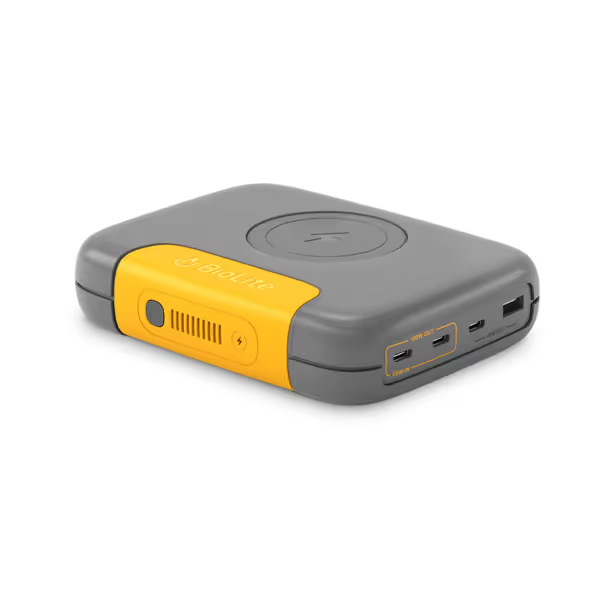
BioLite Charge 100 Max: The Multi-Device Negotiation Master
Best For: Expedition teams needing laptop + phone + camera charging without thermal throttling.
Where most 100W banks overheat and downshift, this uses active thermal management and verified protocol stacking:
Real capacity: 96 Wh (26,000 mAh) delivers 22,500 mAh to devices, only 14% conversion loss vs. industry average 28%.
Simultaneously fast-charge up to five devices, including laptops.
Full recharge in 90 minutes; FAA compliant for travel.
Compact and highly portable for daily carry and travel.
Cons
Some reports of inconsistent long-term durability.
Customers appreciate the power bank's portability, noting it fits in pockets and is good for travel, while also praising its quick charging speed and build quality. However, the charging ability receives mixed feedback - while it holds charge nicely initially, some report it stops working after a few months of use. Moreover, customers disagree on the product's durability, weight, and build quality.
Customers appreciate the power bank's portability, noting it fits in pockets and is good for travel, while also praising its quick charging speed and build quality. However, the charging ability receives mixed feedback - while it holds charge nicely initially, some report it stops working after a few months of use. Moreover, customers disagree on the product's durability, weight, and build quality.
Why it works: 8 Wh/day device draw × 7 days = 56 Wh. Nomad 10 replenishes 15 Wh/day in partial sun, extending bank life 45%.
Measure twice, charge once. I've lost count of expeditions where a $10 cable swap saved the mission. Your bank's specs are meaningless without compatible signaling.
Your Action Plan: 3 Steps Before Your Next Trip
Verify e-marker status: Inspect your cable's USB-IF ID chip (or buy UGREEN/Belkin certified). Non-e-marked cables block >15W.
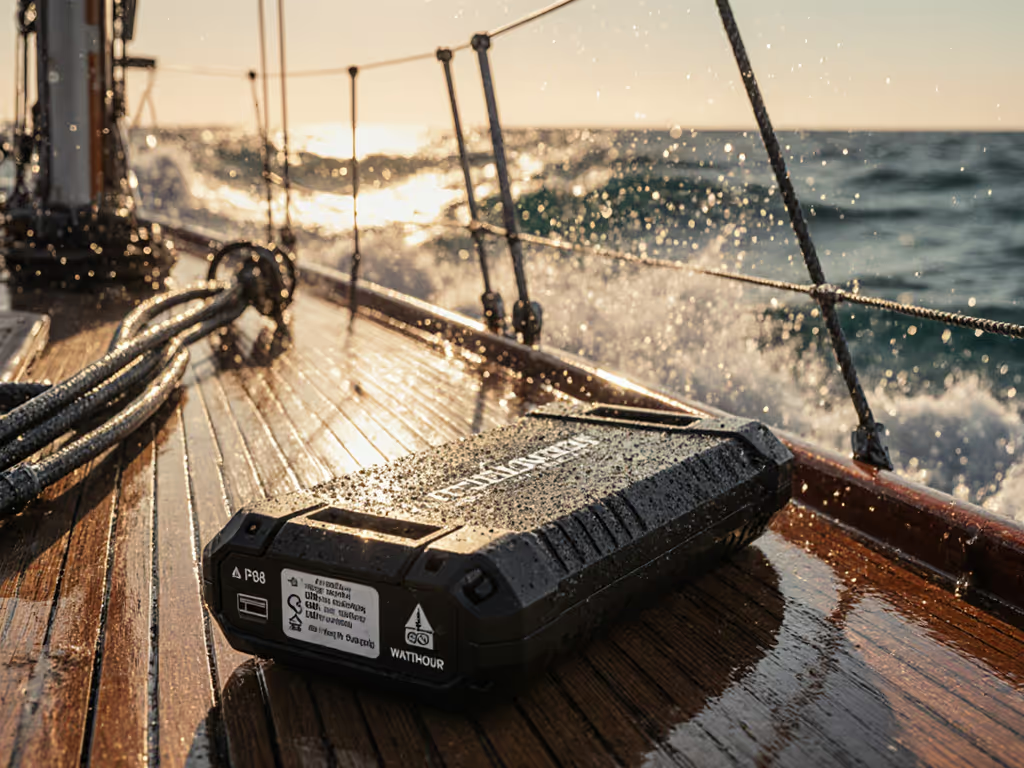
Run a cold test: Charge bank fully, place in freezer 2 hours. Does it deliver 80%+ capacity? If not, it'll fail on trail. If you need hardware that shrugs off rain and drops in the cold, check our rugged power bank comparison.
Cross-load stress test: Charge laptop + phone simultaneously for 20 mins. Monitor wattage drop via a $15 USB meter. >15% drop = avoid for multi-device trips.
Adventure-ready charging isn't about luck. It is engineered predictability. The right hiking power bank recommendations solve your device ecosystem's negotiation path, not theoretical specs. When you pair e-marked cables with protocol-aware banks like the BioLite Charge 100 Max, and supplement with solar that plays nice with the grid (Nomad 10), you transform outdoor sports power needs from a headache into a silent ally. Your summit photos, and safety comms, will thank you.