Power Bank Sharing Economy: Urban Compliance Strategies
By Hana El-Sayed • 17th Dec
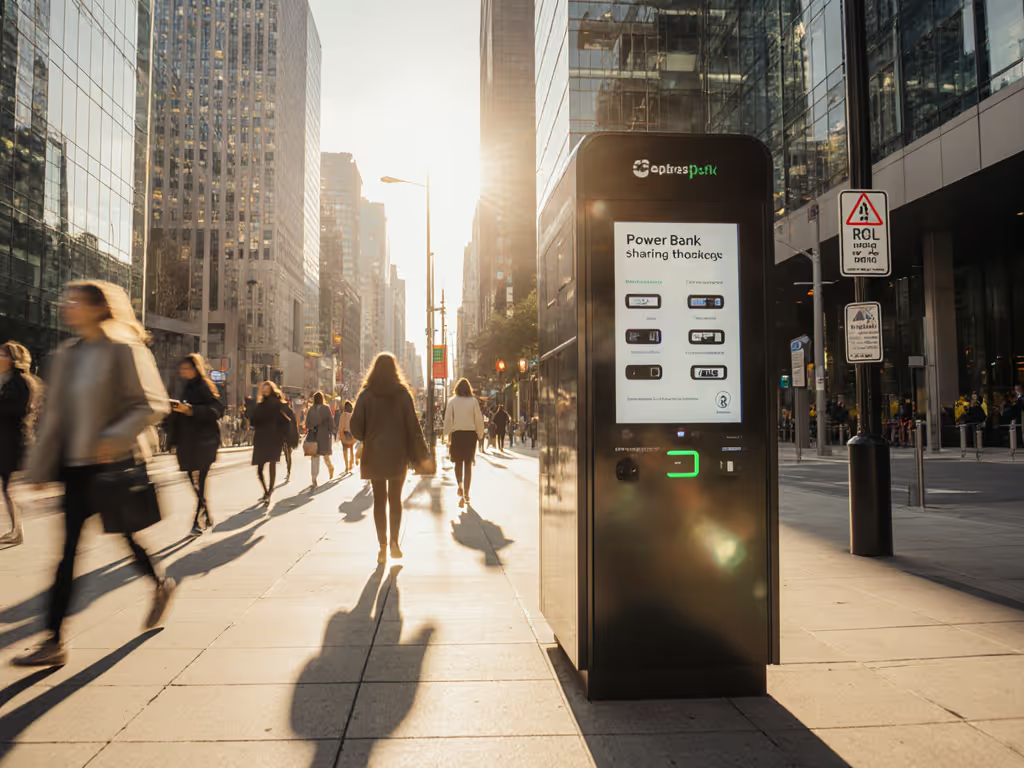
As the power bank sharing economy continues its global expansion, with cities installing hundreds of thousands of public power bank kiosks annually, understanding the compliance landscape has become critical for both operators and users. With market revenue projected to reach USD 1350.75 million in 2024 and grow at 13.8% annually, this infrastructure must meet rigorous safety standards to avoid checkpoint failures and service disruptions. Urban charging infrastructure that prioritizes regulatory adherence from the outset prevents costly operational hiccups and builds consumer trust.
Why Compliance Matters More Than Convenience in Power Bank Sharing
Compliance is a feature, not an afterthought, especially when your business model depends on public deployment across multiple jurisdictions.
Q: What safety standards must shared power banks meet to operate legally? A: The foundation of any reliable power bank sharing service begins with UN38.3 certification, which validates battery safety during transport. Providers must also comply with IEC 62133 for general safety, UL 62368-1 for electronic equipment safety, and local regulations that vary by country. Crucially, each unit must display precise labeling language including watt-hours (Wh), not just milliamp-hours (mAh), to avoid confiscation at transportation hubs. I've seen travelers lose critical work devices because their rental bank lacked proper Wh labeling (something easily preventable with proper documentation audits from the start).
Q: What are the critical compliance considerations for public power bank kiosk placement? A: Urban charging infrastructure requires careful risk matrices and mitigations at each deployment site. Locations like airports, train stations, and entertainment venues must consider:
- Physical security against theft or vandalism
- Fire safety protocols for high-density battery storage
- Electrical safety compliance with local building codes
- Clear acceptance criteria for charging station placement
- Accessibility standards for public use
Transportation hubs present particular challenges, as shared power banks must meet airline carry-on requirements even when deployed at airports. A 2024 industry report confirmed that over 50% of shared power bank usage occurs in dining and entertainment venues, but the 24% usage in transit locations makes compliance with aviation standards non-negotiable.
Q: How does sustainable public charging balance environmental goals with regulatory requirements? A: While the shared economy model reduces e-waste by approximately 60% compared to personal purchases (with an annual loss rate of less than 3%), this sustainability benefit only materializes when units meet safety standards throughout their lifecycle. Comprehensive risk assessments must include proper end-of-life disposal protocols that align with local regulations. For responsible disposal steps and locator resources, read our power bank recycling guide. The environmental sustainability narrative gains credibility when providers can demonstrate compliance with normative references cited in extended producer responsibility laws.
Air Travel Compliance: The Unseen Challenge for Sharing Services
Q: What specific challenges do power bank rental services face at airports? A: Airport deployments create unique compliance demands. While travelers appreciate the convenience of travel charger station access, operators must navigate complex aviation regulations:
- Batteries exceeding 100Wh cannot be transported on aircraft
- Each device must display clear watt-hour ratings (not just mAh)
- UN38.3 test reports must be available for regulatory inspection
- Protection circuitry must prevent thermal runaway
At an airport checkpoint last year, I witnessed a traveler's perfectly functional rental pack get confiscated because the label omitted watt-hours, a preventable situation that derailed their business trip. Travelers can avoid these pitfalls with our airline compliance travel guide. Since then, I've made it standard practice to audit documentation, protection ICs, and UN38.3 reports before any recommendation leaves my desk.
Q: How should travelers verify if a shared power bank meets airline requirements? A: Look for these clear acceptance criteria before renting:
- Visible watt-hour (Wh) rating (not just mAh)
- No visible damage to the unit or charging station
- Manufacturer name and safety certifications displayed
- Protection circuits that prevent overcharging
If these elements are missing, opt for a portable solution you've verified yourself. Some travelers now carry a compliant PRODUCT_FEATURE_BOX(Anker Charging Station) as backup for their work devices when traveling, ensuring they can continue working during layovers without compliance anxiety.
Urban Infrastructure: Building for Long-Term Compliance
Q: What technical specifications should city planners consider when approving public power bank kiosks? A: Municipalities developing urban charging infrastructure guidelines should require:
- Third-party certification documentation for all deployed units
- Clear protocols for battery replacement and disposal
- Protection circuitry specifications (overcharge, short-circuit, thermal)
- Precise labeling language including Wh ratings and safety warnings
- Regular maintenance logs accessible for audit
Cities in APAC have led in creating frameworks for these services, with policies that opened public resources like subway stations to hosting kiosks. Strategic partnerships with high-traffic venues have proven successful where compliance was prioritized from the initial deployment phase.
Q: How do dynamic pricing models impact safety compliance in the sharing economy? A: As pricing increases in popular locations (reaching 7-8 yuan/hour in some entertainment venues), operators must resist cost-cutting on safety features. Higher revenue should correlate with higher safety standards, not the opposite. Market leaders recognize that sustainable public charging requires maintaining safety margins even when margins tighten. When I review power bank rental services, I check whether they've maintained conservative engineering despite pricing pressures.
The Road Ahead: Compliance as Competitive Advantage
The most successful power bank sharing operators treat regulatory requirements not as obstacles but as design specifications. Companies gaining market share increasingly build compliance into their product development lifecycle rather than bolting it on later. This approach delivers tangible benefits:
- Fewer service interruptions at critical locations
- Stronger brand trust among safety-conscious users
- Reduced liability exposure
- Smoother expansion into new markets
As this market grows toward projected $2.5 billion by 2029, the operators who view compliance as a feature, not a hurdle, will dominate the public power bank kiosk landscape. For city planners, travelers, and service providers alike, understanding these compliance frameworks transforms uncertainty into strategic advantage.
Further Exploration For those implementing urban charging infrastructure, I recommend reviewing IEC 62133-2:2017 for secondary lithium cells, UN Manual of Tests and Criteria (Rev.6) for transportation safety, and your local electrical safety regulations. The power bank sharing economy's longevity depends on getting these fundamentals right from deployment through end-of-life management.
Related Articles
Business & Professional Solutions
Noise-Free Power Banks for Musicians: Tested & Ranked
15th Mar•13 min read

Business & Professional Solutions
MIL-STD Power Banks: Proven Ratings vs Marketing Claims
3rd Feb•8 min read
Business & Professional Solutions
Power Bank Kiosk Business ROI: Earn $324/Month Per Unit
22nd Jan•7 min read